Why Coastal and Wildfire Threats Demand Special Roofing Solutions
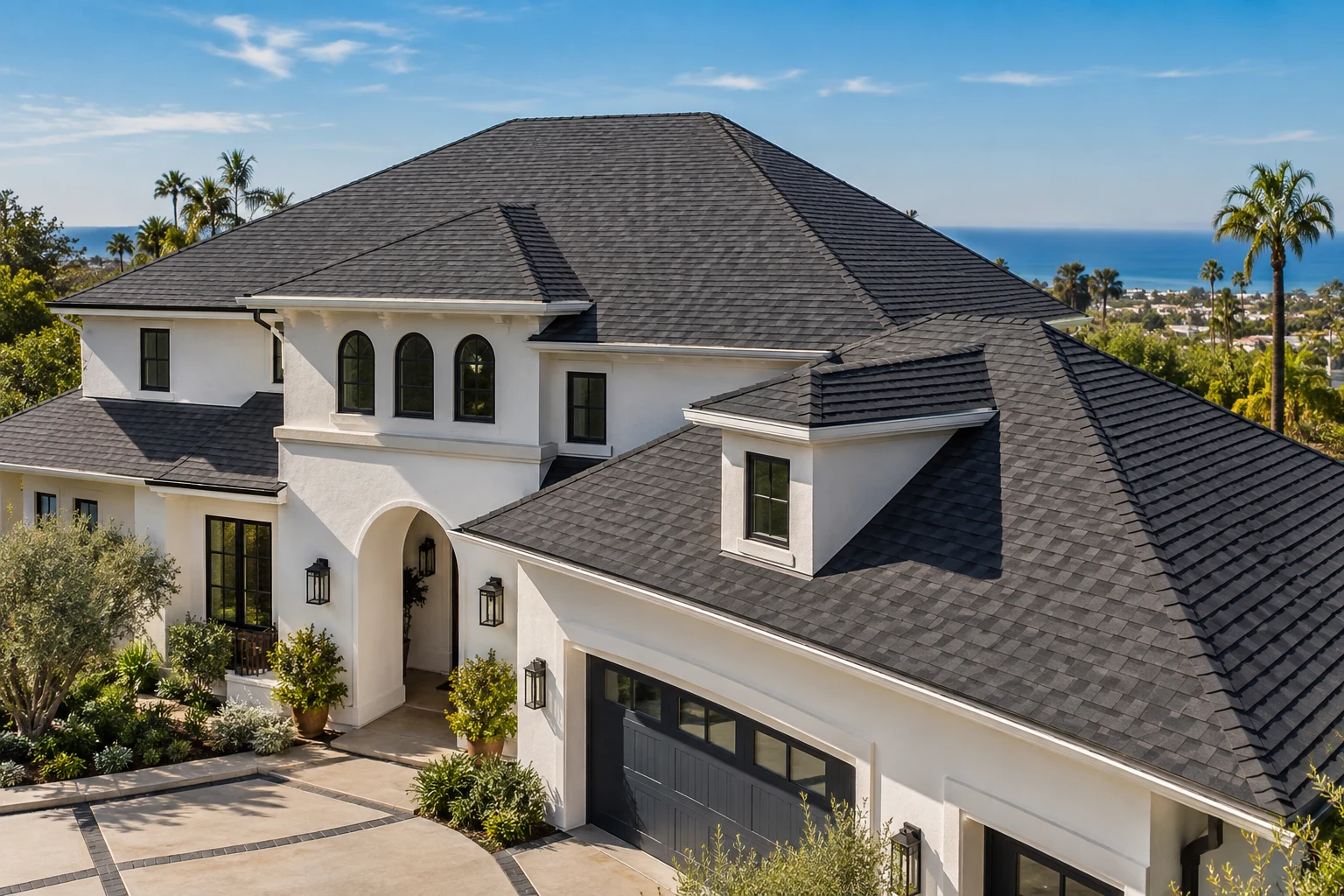
Southern California homeowners live with unique environmental pressures that standard roofing simply cannot handle. Coastal properties face relentless salt spray that corrodes materials from the moment installation is complete. Inland and foothill homes contend with wildfire threats that demand fire-rated materials and ember-resistant design. Both challenges require roofing systems engineered specifically for these conditions, not generic solutions installed elsewhere in the country.
We’ve spent decades watching homeowners in Los Angeles County, Orange County, San Bernardino County, Riverside County, and Ventura County learn this lesson the hard way. A roof that performs well in Arizona or Nevada won’t hold up to our unique climate stressors. The good news: there’s a clear path forward. Understanding these threats and investing in the right materials and installation now prevents costly damage, insurance complications, and premature replacement down the road.
Standard asphalt shingle roofs installed across the country follow a generic formula. They handle wind, rain, and moderate temperature swings. They fail spectacularly in Southern California’s coastal salt environments and high-fire-risk zones.
Consider what happens in a coastal community like Santa Monica or Huntington Beach. Salt-laden air doesn’t just corrode metal flashing and gutters; it penetrates asphalt granules, breaks down sealants, and accelerates granule loss. A roof with a 25-year theoretical lifespan might degrade significantly after 12-15 years of consistent salt exposure.
Wildfire risk zones present an entirely different problem. Embers don’t fall vertically like rain. They travel horizontally on wind currents, lodge in valleys and crevices, and ignite materials from within gaps and vents. Standard architectural shingles offer little protection. Metal roofs, certain tile systems, and Class A fire-rated asphalt shingles resist ignition. Ember resistance depends not just on material but on installation details: proper venting, sealed gaps, and fire-resistant underlayment.
Many homeowners assume their insurance company will cover roof damage from these causes. That assumption frequently backfires. Insurers increasingly deny claims when roofs don’t meet minimum fire ratings or show accelerated deterioration from salt exposure. Proactive investment in resilient roofing protects both your property and your coverage.
Understanding Salt-Air Corrosion and Its Impact on Your Roof
Salt corrosion works differently than typical weathering. Ocean spray carries sodium chloride particles that deposit on roofing materials, metal components, and underlying structures. Unlike rain, salt doesn’t evaporate cleanly; it crystallizes and creates a corrosive environment that persists.
The damage timeline typically unfolds this way: Years 1-3, you notice minor granule loss and slight discoloration. Years 4-6, gutters and metal flashings begin showing rust, and sealants lose adhesion. Years 7-10, widespread granule loss exposes the asphalt base layer, shortening the roof’s lifespan considerably.
Standard asphalt shingles accelerate this process because their granule coating degrades faster under salt stress. Fiberglass-based shingles—cheaper upfront—offer even less protection. Premium asphalt shingles with enhanced granule adhesion and thicker asphalt bases resist salt corrosion far more effectively, though they still require compatible flashing and underlayment materials.
Metal components deserve equal attention. Galvanized steel rusts quickly in coastal environments. Aluminum and stainless steel resist corrosion better but cost more. The smartest coastal roofs use corrosion-resistant metals for all flashings, vents, and trim, paired with premium shingles or salt-resistant tile systems.
Maintenance matters significantly. Regular gutter cleaning, zinc strip installation in valleys, and periodic rinsing of salt residue extend your roof’s lifespan by 3-5 years in coastal zones. That’s not a permanent fix, but it delays major replacement and maintains your investment.
Fire Ratings and Ember Resistance: What You Really Need to Know
Fire ratings confuse homeowners because the terminology sounds scientific but often gets misinterpreted. There are two critical standards: UL classifications and Class A ratings.
A Class A fire rating means the material resists flame spread and doesn’t readily ignite. Most modern asphalt shingles achieve Class A when tested in a laboratory setting. However, Class A doesn’t tell you about ember resistance, wind-driven rain after fire, or how installation gaps affect performance.
UL 1256 testing specifically measures how materials and assemblies respond to burning embers. This is where real-world wildfire protection lives. A roof assembly that passes UL 1256 resists ignition from embers embedded in gaps, crevices, and vents. Installation details matter enormously: uncovered fasteners, gaps between shingles, poorly sealed vents, and inadequate underlayment all create ember pathways.
Insurance companies increasingly require UL 1256 compliance or equivalent testing, not just Class A ratings. In high-risk zones like foothill communities near Riverside, Corona, or Temecula, your policy may mandate ember-resistant roofing or face rate increases or non-renewal.
The practical takeaway: ask your roofing contractor specifically about UL 1256 compliance for the material and installation method. A roofer who can’t answer that question isn’t thinking seriously about fire protection. Class A is a starting point; ember resistance is the real protection.
How Insurance Companies View Roof Resilience in High-Risk Areas
Insurance underwriters assess roof risk through a multi-factor lens. They consider age, condition, material type, fire rating, and location within a fire or coastal zone.
A roof that’s 15+ years old, lacks fire rating documentation, or shows visible deterioration becomes uninsurable at reasonable rates. Some insurers simply won’t renew coverage. Others impose significant rate increases. Newer roofs with documented Class A or Class A+ fire ratings, premium materials, and professional installation profiles as lower risk.
Documentation matters. When you replace your roof, get a detailed invoice specifying materials used, fire ratings, underlayment type, and installation method. Photographs of the completed work help too. Insurance companies want evidence, not assumptions.
Coastal properties face a parallel scrutiny. Insurers review photos for signs of salt corrosion, verify that metal components are corrosion-resistant, and confirm that the roof material choice accounts for coastal exposure. A property in Malibu with a standard asphalt roof will attract higher premiums than the same home with a salt-resistant tile system or premium architectural shingles paired with stainless steel flashing.
The financial implication is significant. A $15,000 roof replacement that includes proper fire and corrosion resistance might save you $2,000-$5,000 annually in insurance premiums. Over a 20-year period, that’s insurance-driven savings of $40,000-$100,000, making the roofing investment essentially free when compared to premium increases.
The Materials That Actually Withstand Coastal and Wildfire Conditions
Not all roofing materials perform equally in Southern California’s environment. Here’s an honest assessment of the main options:
Premium Asphalt Shingles (Class A or A+): These are the workhorse of residential roofing. Quality architectural shingles with enhanced granule adhesion and thicker asphalt bases resist both salt corrosion and fire better than standard options. They’re also the most cost-effective choice. Lifespan in coastal zones: 15-20 years. Fire rating: Achievable with proper installation.
Concrete and Clay Tile: Tile systems resist salt corrosion exceptionally well and offer Class A fire ratings inherently. They’re heavier than shingles, requiring structural verification. Lifespan: 30-50 years. Cost: 40-60% more than premium shingles. They’re ideal for high-end coastal homes and wildfire zones if your home’s framing supports the weight.
Metal Roofing: Standing seam metal roofs resist fire and salt corrosion well, though they require proper sealing and compatibility with underlayment. Lifespan: 30-40 years. Cost: 20-30% more than premium shingles. They’re gaining popularity in fire zones but need professional installation to prevent water infiltration.
Synthetic Slate and Cedar: These engineered materials mimic natural products while improving performance. They resist salt, fire, and fading. Lifespan: 25-35 years. Cost: 30-50% more than premium shingles. They work well for coastal properties seeking aesthetic appeal with durability.
For most Southern California homeowners, premium asphalt shingles paired with corrosion-resistant flashing, Class A fire rating, and professional installation deliver the best value. High-end or high-risk properties benefit from tile or metal systems that offer longer lifespans and superior resilience.
Our Advanced Satellite Technology Identifies Your Specific Risk Factors
We use satellite imagery and mapping technology to assess each property’s specific environmental exposure before recommending materials. This isn’t guesswork; it’s data-driven insight.
For coastal properties, we map your distance from the ocean, wind patterns, and historical salt spray intensity. That data determines which material and metal components make sense for your location. A home two blocks from the beach in Long Beach needs different protection than one five miles inland.
For wildfire zones, satellite technology shows us proximity to known fire corridors, elevation, vegetation density, and historical fire behavior patterns. We then recommend fire ratings and installation details matched to your specific risk. A Malibu hilltop property requires different protection than a Corona neighborhood three miles from the nearest forest.
This technology eliminates one-size-fits-all recommendations. You get a roofing plan engineered for your actual environmental threats, not generic Southern California assumptions. It also provides documentation for insurance purposes, showing underwriters exactly why you chose specific materials and methods.
Why Our Owens Corning Premium Materials Outperform Standard Options
We’re an Owens Corning Preferred Contractor, which means we work exclusively with their premium line of shingles and underlayment systems. There’s a practical reason: their materials consistently outperform cheaper alternatives in our climate.
Owens Corning’s premium asphalt shingles use superior granule adhesion technology that resists salt corrosion and granule loss. Their synthetic underlayment resists moisture penetration while allowing vapor transmission, crucial for coastal humidity and inland temperature swings. Their fire-rated systems achieve Class A+ ratings with installation methods we’ve perfected over decades.
We could install cheaper materials and charge less. Instead, we pair quality materials with professional installation and warranty protection because it’s the right choice for Southern California properties. A $12,000 roof with budget materials that fails in 12 years costs more than a $15,000 premium roof lasting 20+ years.
Our lifetime warranty coverage (available on qualifying installations) reflects confidence in these materials and our installation standards. That protection matters when you’re investing in your home’s long-term safety.
Installation Quality Determines Long-Term Performance and Warranty Protection
Roofing material quality means nothing without professional installation. We’ve seen premium shingles fail because they were installed over inadequate underlayment, with improper fastening, or with gaps that allowed ember penetration.
Installation details that most homeowners never see determine real performance. Proper nail placement (within the nailing strip, not too high or low) affects shingle longevity by years. Adequate fastening density in high-wind zones prevents blow-offs. Proper underlayment overlap and sealing prevents water infiltration. Sealed vents and metal components prevent ember access.
Our 45+ years of combined crew experience translates to installation precision. Our crews don’t rush jobs. They follow manufacturer specifications exactly, photograph work for documentation, and stand behind their installations with lifetime warranties on qualifying projects.
When you choose us, you’re investing not just in materials but in installation quality that extends your roof’s lifespan by 5-10 years compared to average contractor work. That difference compounds over time, making professional installation the most undervalued aspect of roofing value.
Flexible Financing Makes Resilience Affordable for Southern California Homeowners
Coastal and wildfire-resistant roofing costs more than standard options. We don’t minimize that reality. Premium shingles, corrosion-resistant metals, fire-rated underlayment, and professional installation add up quickly.
Financing may be available through third-party lenders for qualified applicants. Availability, APR, fees, down payment, and repayment terms depend on the lender and approval. Review the complete loan terms before accepting.
We also work with insurance companies on coverage claims when fire or storm damage occurs. If your existing roof has damage that justifies replacement, we help document it for claim purposes, potentially reducing your out-of-pocket cost significantly.
Starting a conversation costs nothing and commits to nothing. Our free virtual roof estimates give you accurate pricing and material options for your specific property, so you can make informed decisions with full financial transparency.
Real Protection Starts with a Free Virtual Estimate
We serve homeowners across Southern California including Los Angeles County, Orange County, San Bernardino County, Riverside County, and Ventura County. Whether you live in coastal communities, wildfire-prone foothill areas, or inland neighborhoods, your roof faces specific threats that demand attention.
A free virtual estimate shows you exactly what your home needs. We’ll assess your property’s environmental exposure, recommend appropriate materials and methods, provide transparent pricing, and discuss financing options. You’ll leave the conversation with a clear understanding of your roof’s condition and the value of investing in resilience.
Contact us today to schedule your free virtual roof estimate. Protecting your Southern California home starts with understanding its unique needs and choosing a contractor who knows how to address them.
For further reading: Ventura County roofing, Free virtual roof estimates.
Request a Free Roof Estimate If you’re considering roof replacement for your home, starting with a virtual estimate allows you to gather information without pressure. It’s a practical way to understand scope, cost, and options before scheduling an on-site visit. Call (310) 729-3013 or visit https://teamallstarconstruction.com/contact/
Frequently Asked Questions (FAQ)
Does my roof need to be fire-rated to get homeowners insurance in coastal and wildfire-prone areas?
Many insurance companies in Southern California now require Class A fire-rated roofing materials for homes in high-risk zones, and some insurers may deny coverage or increase premiums without it. We help you understand your specific insurance requirements by using our advanced satellite technology to assess your property’s risk factors and recommend materials that meet both your insurer’s standards and local building codes.
Getting ahead of these requirements now can save you thousands in potential rate increases or coverage gaps down the road.
What materials do we use that actually resist salt air corrosion and wildfires?
We specialize in premium asphalt shingles and tile roofing from Owens Corning that are engineered to withstand both salt spray degradation and ember exposure without sacrificing durability or aesthetics. Our materials are tested for coastal longevity and fire resistance, so you’re protected whether your home faces ocean salt air or wildfire-prone regions. We’ll recommend the right product for your specific Southern California location during your free virtual satellite estimate.
How does installation quality affect my roof’s performance in harsh coastal and wildfire conditions?
Improper installation creates vulnerabilities that salt air and embers can exploit, potentially voiding warranties and compromising your home’s protection when you need it most. We use installation techniques specifically designed for Southern California’s challenging climate, ensuring proper sealing, ventilation, and fastening that maximizes your material’s lifespan and warranty protection.
Our combined 45+ years of experience means you’re getting proven methods that actually hold up to real-world coastal and wildfire exposure.