
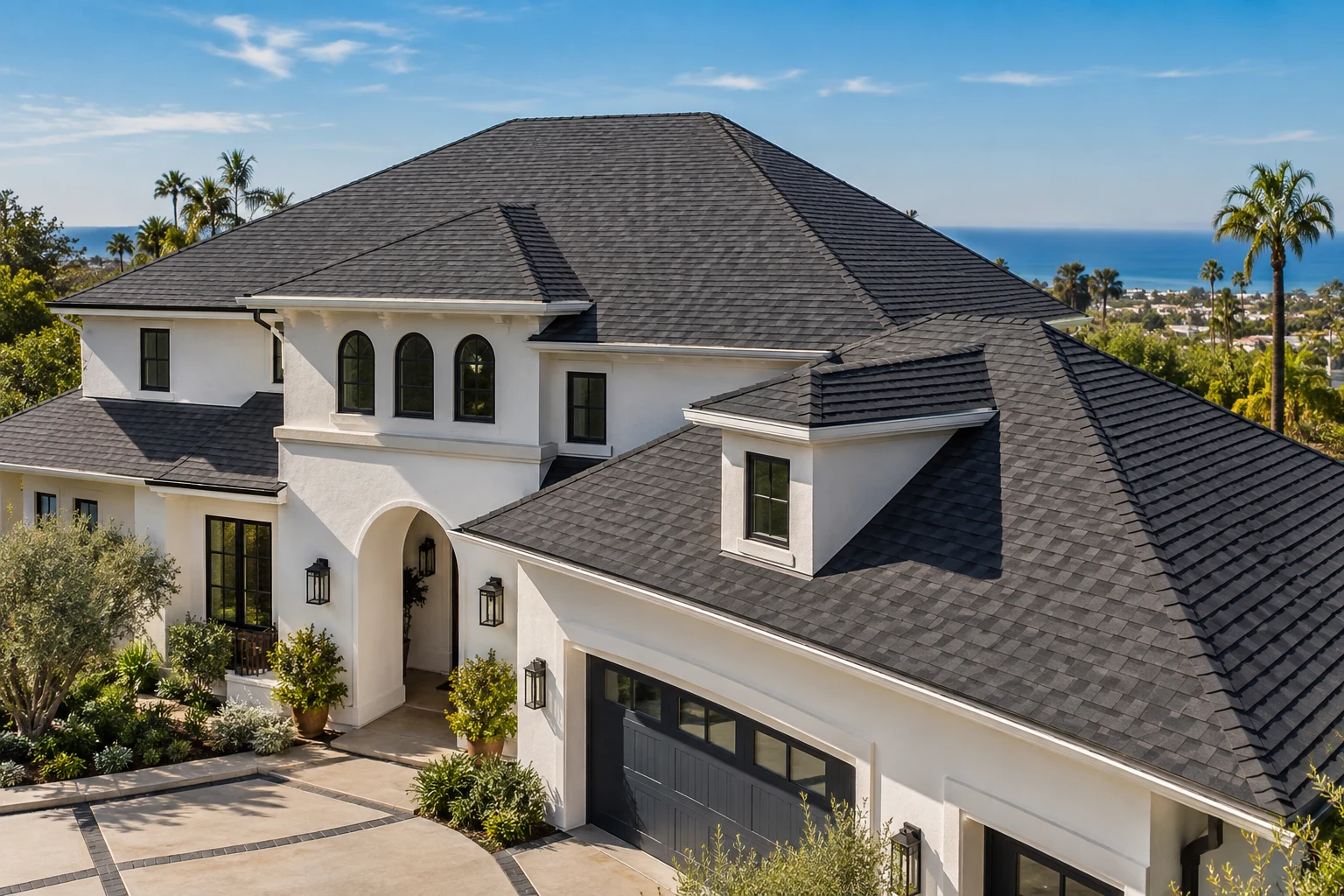
Understanding Your Roof’s Current Condition
When you notice roof damage, the first question isn’t usually “How much will this cost?” It’s “Do I really need a whole new roof, or can this just be fixed?” That’s a smart instinct. Not every damaged roof needs replacement, and pushing a repair when it will hold is wasteful. But ignoring warning signs and repeatedly patching a failing roof can cost you far more in the long run.
We’ve spent over 45 years helping Southern California homeowners navigate this exact decision. The answer depends on several concrete factors: your roof’s age, the extent of damage, what materials you have, and whether you’re solving today’s problem or preventing tomorrow’s. Let’s walk through how to assess your situation honestly.
Start by examining what you can see from the ground or a safe vantage point. Look for obvious signs: missing or curling shingles, visible wear along the edges, dark patches that might indicate moss or algae, or debris clogging your gutters. Take photos if possible.
Then ask yourself these basic questions: Can you spot the damage from your yard? Does it cover a concentrated area (a corner or one slope) or spread across multiple sections? Have you had leaks inside, or is this purely cosmetic? These details matter because they hint at whether you’re dealing with localized wear or systemic failure.
If your roof is under 15 years old and the damage appears isolated to one section, a repair often makes sense. But if you’re noticing multiple problem areas, previous patches, or signs of weathering across the whole roof, replacement is likely already on the horizon. Don’t wait for a major leak to force the decision.
What to do next: Walk around your entire roof’s perimeter on the ground and document what you see. Note the year your roof was installed if that information is available in your home records.
Key Differences Between Repair and Replacement
A repair addresses a specific problem: a few missing shingles, a localized leak, or damage from a tree branch. A roofer removes and replaces the affected section, restoring function to that area without touching the rest of the roof.
A replacement removes the entire old roof system (and sometimes the underlayment) and installs a new one from scratch. This isn’t just about new shingles; it includes new flashing, updated underlayment, and a fresh structural assessment. You’re getting a complete refresh, not a patch.
Repairs are faster and cheaper upfront. A single damaged section might cost a few hundred to a couple thousand dollars and take a day or two. Replacements take longer, cost more initially, but they reset your roof’s lifespan to 20-30 years depending on materials.
The trap many homeowners fall into is doing multiple repairs on the same roof over several years. That first repair costs $500. Two years later, another $800. A few years after that, $1,200 more. By the time you add it up, you’ve spent $3,500 on a roof that’s still aging and still failing. A replacement would have cost more upfront but ended the problem permanently.
What to do next: Ask yourself honestly whether the damage you’re seeing is the first problem this roof has had, or part of a pattern.
Age and Lifespan Comparison
Your roof’s age is one of the strongest signals for this decision. Standard asphalt shingles last 20-25 years in Southern California’s climate. Premium shingles might stretch to 30. Tile roofs last 40-60 years. Metal roofing can exceed 50.
If your roof is under 15 years old, you likely have repairs ahead of you, not replacement. Repairs are reasonable during this window. Between 15 and 20 years, the calculus shifts. Your roof is still functional, but its remaining life is shrinking. Damage that occurs now means you’re fixing an aging system with fewer years left.
Over 20 years, replacement becomes the economical choice. Even if your current roof doesn’t leak, aging shingles lose flexibility, granules shed, and weather resistance declines. You’re not just fixing today’s damage; you’re preventing tomorrow’s cascading failures.
Southern California’s sun is harder on roofs than many regions. UV exposure degrades shingles faster than in cooler climates. If you’re in Los Angeles County, inland areas of San Bernardino County, or anywhere facing intense summer heat, expect the lower end of typical lifespan.
What to do next: Find out your roof’s installation date (check with your mortgage company, previous sellers, or roofing records). Calculate how many years it has left realistically.
Cost Analysis: Short-Term vs Long-Term Investment
Let’s talk numbers, because this is where homeowners often make their decision.
A roof repair for a localized issue typically runs $300 to $2,500, depending on the extent and your location. You get immediate relief and low out-of-pocket cost.
A roof replacement for a typical Southern California home (2,000-2,500 square feet) costs between $8,000 and $25,000 depending on materials, roof complexity, and local labor rates. That’s a serious investment. Asphalt shingles land on the lower end; tile or premium materials on the higher end.
But zoom out five years. If you repair a 20-year-old roof now for $1,500, then again for $2,000 in three years, you’ve spent $3,500 and still have a roof nearing the end of its life. A replacement done today costs more upfront but stops the cycle. You’re not back on a ladder in three years. You’re not managing emergency leaks during rainy season.
Over 10-15 years, replacement costs less total than the repair-repair-replace pattern. Plus, you get the intangible benefit of knowing your roof is secure and under warranty.
What to do next: Get a detailed estimate for repair and ask the contractor to project how long the roof will hold before major problems likely return.
Damage Severity Assessment Criteria
Not all damage is equal. Learning to assess severity helps you separate what’s actually urgent from what can wait.
Minor damage: A few missing shingles, small cracks, localized wear. Repair is appropriate. Cost is low, and it buys time.
Moderate damage: Multiple damaged areas spread across the roof, missing sections of flashing, signs of previous poor repairs, or visible water staining on interior ceilings. This is the uncomfortable middle ground. Repair might address the immediate leak, but you’re managing a roof in decline. Replacement becomes worth considering seriously.
Severe damage: Widespread missing or curled shingles, sagging sections, obvious structural issues, or persistent leaks despite previous repairs. This roof is failing. Replacement is not optional; it’s necessary.
The key insight: damage severity isn’t just about what you can see today. It’s about what that damage tells you about the roof’s overall condition. A single missing shingle on a 10-year-old roof is different from five missing shingles on a 23-year-old roof. The second one signals systematic aging, not isolated damage.
What to do next: Take photos of any damage from multiple angles and compare it against these severity levels honestly.
Weather Damage and Environmental Factors
Southern California’s weather varies dramatically by region. Coastal areas face salt spray and moisture. Inland deserts endure intense heat and UV. Mountains experience wind and hail. These environmental stresses age roofs differently.
High winds can lift shingles, especially in areas around Ventura County or the higher elevations of San Bernardino County. Hail is less common but catastrophic when it hits. Heat in the inland empire (Riverside County and east) accelerates aging and causes expansion-contraction cycles that crack and curl shingles. Salt air near the coast corrodes metal components and deteriorates certain materials faster.
After a severe weather event, inspect your roof within a week if safe to do so. Wind damage might not show as leaks immediately but compromises the roof’s integrity. A repair after a weather event might be cosmetic (replacing blown-off shingles) or structural (addressing underlayment damage). If weather has damaged your roof and you’re already 18+ years in, that damage might tip the decision toward replacement.
We serve homes across Riverside County roofing and Orange County roofing conditions, and climate-specific damage patterns matter. A roof holding fine in coastal Irvine might be stressed in the Coachella Valley.
What to do next: Check your homeowner’s insurance claim history. Multiple weather-related claims signal a pattern of vulnerability.
Our Satellite Inspection Advantage
Here’s where we give you a real advantage. Rather than squinting from a ladder or hiring someone to climb around, we use advanced satellite technology to assess your roof’s condition comprehensively and safely.
Our satellite inspection process captures high-resolution imagery of your entire roof system. We analyze shingle condition, identify water staining patterns, spot problem areas you might miss, and assess age-related wear. We then provide you a detailed report showing exactly what we’re seeing and what it means for your roof’s future.
This removes guesswork. You’re not deciding repair vs. replacement based on a phone photo or a contractor’s quick visual. You’re seeing professional analysis of your actual roof in detail. We’ve found that many homeowners are pleasantly surprised to learn their roof is better than expected, or frankly confronted with the reality that replacement is necessary sooner than they thought.
The inspection is free, which means you get professional-grade information with zero commitment. We send you a detailed report you can review at your own pace and discuss with family or other contractors if you want.
Get your free virtual roof estimates to start with actual data rather than assumptions.
What to do next: Schedule your satellite estimate. The information alone clarifies your options and removes emotional decision-making from the equation.
Why Replacement Wins for Long-Term Protection
If your inspection reveals an aging roof with multiple issues, replacement isn’t just the expensive option. It’s the protective one.
A new roof solves multiple problems at once. You get structural integrity verified, underlying damage found and corrected, modern underlayment that resists moisture better, updated flashing that prevents water intrusion, and a warranty covering your investment for decades.
Repairs patch the visible problem but don’t address the aging system underneath. You might fix a leak in one spot while water is already backing up under the shingles elsewhere. You might replace shingles while the underlying felt is deteriorating.
More importantly, replacement resets your peace of mind. You’re not worried about the roof. You’re not budgeting for the next emergency repair. You’re not stress-testing your roof every time it rains hard or gets windy. Homeowners with newer roofs report feeling genuinely different about their homes’ security and longevity.
Over 20-30 years (the lifespan of a new roof), that peace of mind compounds. You can plan, invest in other home improvements, and sell your home without roof concerns hanging over the transaction.
What to do next: Consider replacement not just as an expense but as an investment in your home’s structural integrity and your own well-being.
Financing Options That Make Replacement Affordable
The biggest barrier to replacement is the upfront cost. We get it. We’ve designed financing options specifically to remove that barrier.
We offer flexible financing with $0 down, meaning you don’t need to empty savings or go into credit card debt to protect your home. You can spread payments across a term that fits your budget. No hidden fees, no surprises.
For homeowners whose roofs qualify, we also partner with manufacturers to offer rebates and incentives on premium materials. Owens Corning Preferred Contractor status means you get access to factory-backed warranties and promotional financing options other contractors can’t offer.
Some homeowners can also deduct roof replacement on taxes if damage is storm-related and not covered by insurance. Check with your tax professional, but the option sometimes exists.
The point: replacement isn’t as financially out of reach as many homeowners assume. When you break down the monthly cost over the roof’s lifespan, it often compares favorably to years of repairs on an aging system.
What to do next: Ask about financing options during your free estimate. Many homeowners are surprised by how affordable terms can be.
Timeline and Disruption Considerations
A repair takes a day, maybe two. A replacement takes longer, typically 3-5 days depending on your home’s size and roof complexity.
During replacement, there will be noise, crew activity, and some disruption. Roofing involves power tools, shouting, and heavy footsteps. If you work from home or have young children napping, plan accordingly. Most jobs finish before mid-afternoon, so evening and overnight are usually quiet.
The timeline is actually an argument for replacement if you’re considering it. One disruption period to solve the problem permanently beats multiple disruptions over years as repairs stack up. After three days of noise, your roof is done for 25+ years. Compare that to living with the uncertainty of an aging roof and the disruption of repairs every few years.
We also plan replacements around weather. We don’t work in heavy rain, and we coordinate with you to find a window that works with your schedule.
What to do next: If you’re leaning toward replacement, ask about scheduling around your life and weather patterns.
Warranty and Peace of Mind Benefits
Here’s something repairs don’t provide: warranty protection. Most repair work comes with a 1-2 year guarantee on that specific section. After that, you’re on your own.
Material and workmanship warranties have separate terms. Coverage depends on the selected products, installation program, and written warranty; review the duration, exclusions, transfer rules, and claim process before proceeding.
For Owens Corning materials, you also get access to their preferred contractor network, meaning warranty service is honored consistently. You’re not betting on a single contractor staying in business for decades.
That warranty isn’t just legal protection. It’s proof that we’re confident in our work. We wouldn’t guarantee a roof unless we trusted our installation quality. That confidence should transfer to you.
Many homeowners say that warranty relief is worth the replacement cost alone. You’re covered. You don’t have to worry.
What to do next: Review the specific warranty options during your estimate and choose the level of coverage that matches your comfort level.
Schedule Your Free Satellite Estimate Today
You’ve thought through the factors. You know the questions to ask. Now you need actual data about your specific roof.
Our satellite inspection and free estimate report gives you that data. No sales pitch, no pressure, no climbing ladders yourself. You’ll get a detailed analysis of your roof’s condition, clear recommendations based on what we actually see, and transparent pricing for whatever path makes sense.
If repair is the right choice, we’ll tell you that. If replacement makes more sense, we’ll explain why and show you financing options that fit your budget. If your roof is holding up better than you feared, you’ll have that peace of mind.
We serve Los Angeles County roofing and across Southern California from the coast through the inland valleys. Whether you’re in Santa Monica, Ontario, Riverside, or anywhere in between, we can assess your roof and guide your decision with professional insight backed by nearly 50 years of combined experience.
Get your free virtual roof estimate right now. One small step toward clarity and confidence in your home’s most important protection.
Request a Free Roof Estimate If you’re considering roof replacement for your home, starting with a virtual estimate allows you to gather information without pressure. It’s a practical way to understand scope, cost, and options before scheduling an on-site visit. Call (310) 729-3013 or visit https://teamallstarconstruction.com/contact/
Frequently Asked Questions (FAQ)
How do we help you decide between repair and replacement?
We start by evaluating your roof’s age, damage severity, and repair history to give you an honest assessment. Our team uses advanced satellite technology to inspect your roof virtually at no cost, then walks you through whether patching will solve your problem or if replacement makes better financial sense long-term. We focus on what’s actually best for your home, not pushing unnecessary work.
What makes replacement a better investment than repeated repairs?
We’ve seen homeowners spend thousands on repairs only to face replacement within a few years anyway. If your roof is over 15-20 years old or showing widespread damage, replacement stops the cycle of temporary fixes and gives you our lifetime warranty protection. A new roof also improves your home’s value and energy efficiency in ways repairs simply cannot.
Do we offer financing that makes roof replacement affordable?
Yes, we work with flexible financing partners that allow you to replace your roof with $0 down and payments that fit your budget. This approach lets you address roof damage now rather than waiting until an emergency forces a rushed decision at higher costs.