
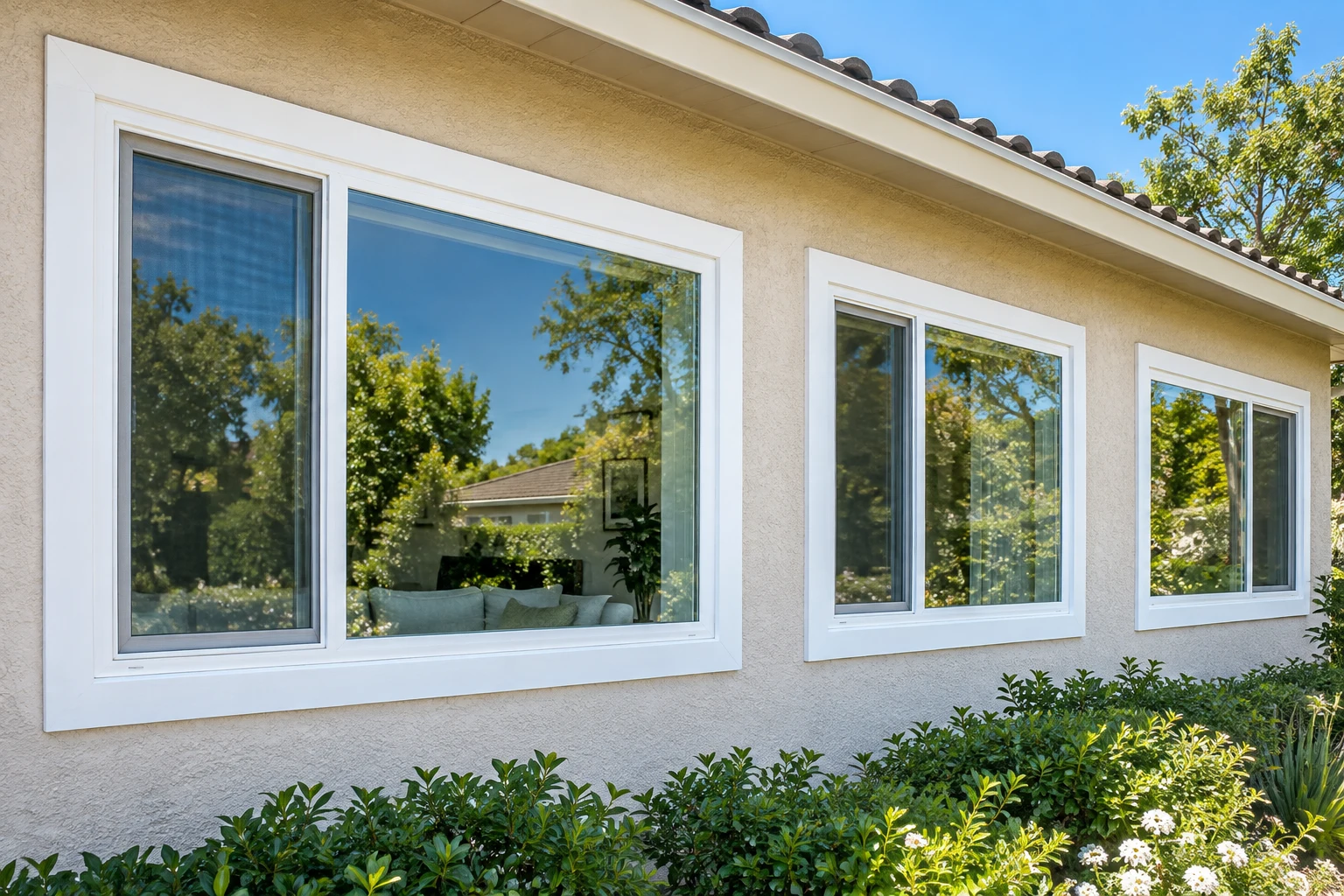
Low-E windows are windows with a special coating that reflects heat while still allowing light to pass through. In Huntington Beach, this means less heat entering your home through the glass, especially during long sunny days near the coast. At Total Home Windows, we use Low-E technology to directly address the real issue most homeowners face—excess heat coming through their windows, not just inefficient air conditioning.
If your home feels warm even with the AC running, the problem often isn’t your cooling system. It’s your windows allowing solar heat to pass inside. You can explore how this issue shows up locally on our
Huntington Beach service area page,
where we break down why so many homes struggle with indoor comfort.
How Low-E Windows Actually Work
Low-E stands for “low emissivity,” which refers to a microscopic coating applied to the glass. This coating reflects infrared heat while still letting visible light in. In simple terms, it blocks heat without making your home dark.
In Huntington Beach homes, this matters because sunlight carries heat. When that heat passes through standard glass, it raises indoor temperatures quickly—especially in rooms with direct sun exposure.
Low-E windows reduce that heat transfer. Instead of heat entering your home, much of it is reflected back outside.
Short answer: Low-E windows are designed to block heat at the glass level, which helps keep your home cooler without overworking your AC.
Why Low-E Windows Matter in Huntington Beach
Huntington Beach has a unique climate. While coastal breezes help, the sun exposure is consistent year-round. Many homes—especially those built before modern energy standards—still have older windows that were never designed to manage heat effectively.
A common issue we find in homes across Huntington Beach is uneven temperatures. One room feels comfortable, while another feels noticeably warmer. This usually happens because certain windows are taking on more direct sunlight and transferring that heat inside.
Low-E windows directly address this by reducing solar heat gain at the source.
Short answer: In a sunny coastal city like Huntington Beach, Low-E windows help stabilize indoor temperatures by reducing heat coming through sun-facing glass.
The Real Problem: Heat Comes Through Windows
Most homeowners assume their AC system is the issue when their home won’t cool down. In reality, the AC is often working correctly—it’s just constantly fighting incoming heat.
Windows are one of the biggest sources of that heat.
In homes across Huntington Beach, we often see older single-pane or early dual-pane windows allowing significant heat transfer. Even if they look fine, they’re not performing well by today’s standards.
This is why some homes feel hot even after running the AC all day. If heat is continuously entering through the glass, the system can’t catch up.
You can learn more about this issue here:
why homes feel hot even with AC in Huntington Beach.
Short answer: If your home won’t stay cool, your windows are likely allowing heat in faster than your AC can remove it.
What Makes Low-E Glass Different From Standard Glass
Standard glass does very little to stop heat. It allows both light and infrared energy to pass through easily. That’s why sitting near a window can feel noticeably hotter, even indoors.
Low-E glass changes that dynamic by adding a reflective layer that targets heat specifically.
- Reflects infrared heat away from your home
- Reduces UV rays that can fade flooring and furniture
- Maintains natural light without dark tinting
- Improves overall insulation when paired with dual-pane systems
In practical terms, this means rooms stay cooler, temperature swings are reduced, and your AC doesn’t have to work as hard.
Short answer: Low-E glass performs differently because it reflects heat instead of absorbing and passing it through like standard glass.
How We Evaluate Low-E Performance in Your Home
At Total Home Windows, we don’t recommend Low-E windows based on assumptions. We show you exactly where heat is entering your home and how your current windows are performing.
A common issue we find is that not all windows in a home perform the same. South- and west-facing windows often bring in the most heat, while shaded areas may perform better.
We measure heat at the window level and explain what’s happening in real time. This allows you to see the problem before deciding on any solution.
From there, we determine whether Low-E glass will make a measurable difference—and where it matters most.
Short answer: We identify heat entry points first, then use Low-E solutions where they will have the biggest impact.
Do Low-E Windows Actually Lower Energy Bills?
Yes—but not in the way most people expect.
Low-E windows don’t “save energy” on their own. They reduce the amount of heat entering your home, which means your AC runs less often and for shorter periods.
In Huntington Beach, where cooling demand is steady due to sun exposure, this can make a noticeable difference over time.
If you’re considering upgrades, you can also explore how
new windows reduce energy bills in Huntington Beach
based on real performance improvements.
Short answer: Low-E windows lower energy bills by reducing heat gain, which reduces how hard your AC has to work.
Are Low-E Windows Enough on Their Own?
Low-E coating is important, but it’s only one part of the system. The overall performance depends on the full window unit—glass, frame, seals, and installation.
In homes across Huntington Beach, we often see situations where the glass may be upgraded, but poor installation or outdated frames still allow air leaks and heat transfer.
That’s why Low-E works best when combined with a properly installed, energy-efficient window system.
If you’re evaluating your options, our
window replacement in Huntington Beach
service focuses on the full solution—not just the glass.
Short answer: Low-E windows are most effective when they’re part of a complete, properly installed window system.
Why Many Huntington Beach Homes Still Struggle With Heat
Even in a coastal city, heat is a persistent issue—especially in homes with older windows.
Many properties in Huntington Beach were built before modern energy standards. That means the original windows were not designed to block heat effectively.
Over time, seals degrade, glass technology becomes outdated, and performance drops further.
In homes across Huntington Beach, we often see this pattern: the AC works, but comfort never improves. Rooms stay warm, energy bills climb, and the problem continues year after year.
Short answer: Older windows in Huntington Beach homes allow continuous heat gain, which leads to ongoing comfort and energy issues.
How Low-E Windows Compare to Standard and Older Windows
The difference between Low-E windows and older windows is not subtle—it’s measurable inside your home.
Standard single-pane glass allows heat to pass through almost freely. Early dual-pane windows improved insulation slightly, but many still lack any meaningful heat-reflective technology. That means they slow heat transfer, but they don’t stop it.
Low-E windows are designed specifically to manage solar heat gain.
- Single-pane windows: little to no heat resistance
- Older dual-pane: moderate insulation, poor heat reflection
- Low-E dual-pane: reflects heat while insulating the home
In Huntington Beach, where sun exposure is consistent, this difference shows up quickly. Homes with older glass heat up faster during the day and stay warm longer into the evening.
Direct answer: Low-E windows outperform older windows by actively reflecting heat instead of simply slowing it down.
What Homeowners Actually Notice After Installing Low-E Windows
Most homeowners don’t care about technical specs—they care about how their home feels.
After installing Low-E windows, the most common changes we hear are:
- Rooms that used to feel hot become usable again
- Less temperature difference between rooms
- AC doesn’t run as often or as long
- Less direct heat near windows during the afternoon
One pattern we consistently see in Huntington Beach homes is that west-facing rooms—especially living rooms and upstairs bedrooms—benefit the most. These areas take the brunt of afternoon sun, and Low-E glass significantly reduces that heat load.
Another common observation: homeowners often realize their AC was never the real issue. Once the heat coming through the windows is reduced, the system suddenly performs the way it should have all along.
Direct answer: The biggest improvement is comfort—cooler rooms, more consistent temperatures, and less reliance on AC.
Are Low-E Windows Worth the Cost in Huntington Beach?
Low-E windows typically cost more than basic glass options, but the decision isn’t about glass alone—it’s about performance.
In Huntington Beach, where cooling demand is driven by sunlight rather than extreme outdoor temperatures, reducing solar heat gain has a direct impact on comfort and energy use.
The cost of window replacement depends on several factors:
- Size and number of windows
- Frame material (vinyl vs fiberglass)
- Glass package (standard vs Low-E upgrades)
- Installation complexity
What matters is whether the upgrade solves the problem you’re actually experiencing. If your home is overheating during the day, Low-E glass is one of the most effective ways to address it.
At Total Home Windows, we don’t push upgrades unless we can show the impact inside your home first. If Low-E isn’t going to make a measurable difference, we’ll tell you.
Direct answer: Low-E windows are worth it when heat gain is the issue—which is the case in most Huntington Beach homes.
Low-E Glass vs Other Heat-Blocking Options
Some homeowners consider alternatives like tinted film, blinds, or curtains to block heat. These can help, but they don’t solve the root problem.
Window film reduces some heat, but it’s applied to existing glass that still conducts heat. Blinds and curtains block light after the heat has already entered the space.
Low-E glass works differently. It reflects heat before it enters your home.
If your goal is to reduce indoor temperature—not just glare—this distinction matters.
For a deeper look at performance-focused solutions, you can explore
the best windows to block heat in Huntington Beach.
Direct answer: Low-E glass is more effective than films or coverings because it stops heat at the source, not after it enters.
When Low-E Windows Make the Biggest Impact
Not every window in your home performs the same, and not every window needs the same level of upgrade.
Low-E windows have the greatest impact in:
- South-facing windows with all-day sun exposure
- West-facing windows exposed to intense afternoon heat
- Large glass areas like sliders or picture windows
- Rooms that consistently feel hotter than the rest of the house
In many Huntington Beach homes, we find that a few key areas are responsible for most of the heat gain. Addressing those areas properly often changes the overall comfort of the home.
This is why we measure first. You may not need to replace every window—but you do need to fix the ones causing the problem.
Installation Matters More Than Most People Realize
Even the best Low-E glass won’t perform properly if the window is poorly installed.
Gaps, poor sealing, or misalignment allow air and heat to bypass the glass entirely. This is something we see often when homeowners have had previous window work done without proper inspection or fitting.
At Total Home Windows, we focus on the full system:
- Correct sizing for each opening
- Proper sealing to eliminate air leaks
- Frame and glass working together as a unit
This ensures the Low-E coating does what it’s supposed to do—reduce heat transfer at the glass level without being undermined by installation issues.
Should You Replace All Windows or Just Problem Areas?
This is one of the most common questions we get.
The answer depends on what we find during the evaluation.
If heat is entering primarily through a few windows, targeted replacement can be effective. If the entire home has outdated windows, a full replacement often delivers better long-term results.
In Huntington Beach, many homes fall somewhere in between—some windows are failing, while others are still functional but inefficient.
We walk you through that difference so you can make a decision based on actual conditions, not assumptions.
Making the Right Decision for Your Home
Low-E windows are not a trend or an upgrade for appearance—they are a performance solution.
If your home feels hot, uneven, or uncomfortable, the issue is usually tied to heat entering through the glass. Once that’s addressed, everything else—from your AC to your energy usage—starts to improve.
At Total Home Windows, our approach is simple: identify the problem, show you the proof, and recommend a solution that actually fixes it.
No guessing. No generic recommendations. Just clear answers based on what’s happening inside your home.
Frequently Asked Questions About Low-E Windows in Huntington Beach
Do Low-E windows really make a noticeable difference?
Yes. Most homeowners notice reduced heat near windows, more consistent indoor temperatures, and less strain on their AC system within the first few weeks.
How much more do Low-E windows cost?
Low-E glass typically adds to the cost compared to standard glass, but the exact difference depends on the window type and size. The key is whether it solves your heat problem—which we verify before recommending it.
Will Low-E windows make my home darker?
No. Low-E coatings are designed to reflect heat, not block natural light. Your home will still feel bright without the added heat.
How long does installation take?
Most window installations are completed within one to two days, depending on the number of windows and complexity of the project.
Can I upgrade just a few windows to Low-E?
Yes. Many homeowners start with the hottest areas of the home. We help identify which windows will deliver the biggest improvement.
Related Window Answers in Huntington Beach
- Are energy-efficient windows worth it in Huntington Beach?
- Dual-pane vs triple-pane windows in coastal California
- What does window replacement cost in Huntington Beach?
- Should you replace all windows at once?
Get Your Free Window Replacement Estimate In Huntington Beach
If your home still feels hot even with the AC running, it’s time to find out why. Total Home Windows will show you exactly where heat is entering and whether Low-E windows will make a real difference in your home.
Call us at (310) 729-3013, email teamallstarconstruction@gmail.com, or request an estimate through our
We don’t guess—we measure, show you the problem, and help you fix it the right way.
Request Free Estimate
Related Content
Best Windows for Homes in Huntington Beach
Should I Replace All Windows At Once in Huntington Beach
What Type Of Windows Are Best For Hot Climates in Huntington Beach
Milgard Vs Andersen Windows in Huntington Beach
Vinyl vs Fiberglass Windows in Huntington Beach
Best Window Brands in Huntington Beach
Helpful Resources for Homeowners
Whether you’re researching energy-efficient windows, looking for ways to reduce heat and noise, or comparing replacement options for an older home, these resources cover some of the most common questions homeowners ask. Browse the articles below for practical guidance and expert insights on choosing the right windows for your home.