Prices and performance figures in this guide are planning examples, not a project quote or a promise of savings. Your estimate and results depend on the products, installation scope, existing home, climate, and energy use.
Why Window Fill Matters for Your Home’s Comfort and Costs
When your home stays hot even with the AC running, the problem is usually heat pouring through your windows. We see this constantly across Southern California—homeowners feel the difference between rooms with old windows and newer ones. That temperature gap tells you something important: what’s between the glass layers matters.
The gap between window panes is filled with either air or argon gas. That simple choice affects how much heat enters your home and how much you pay to cool it. We’ll walk you through what’s actually happening so you can make the right decision for your situation.
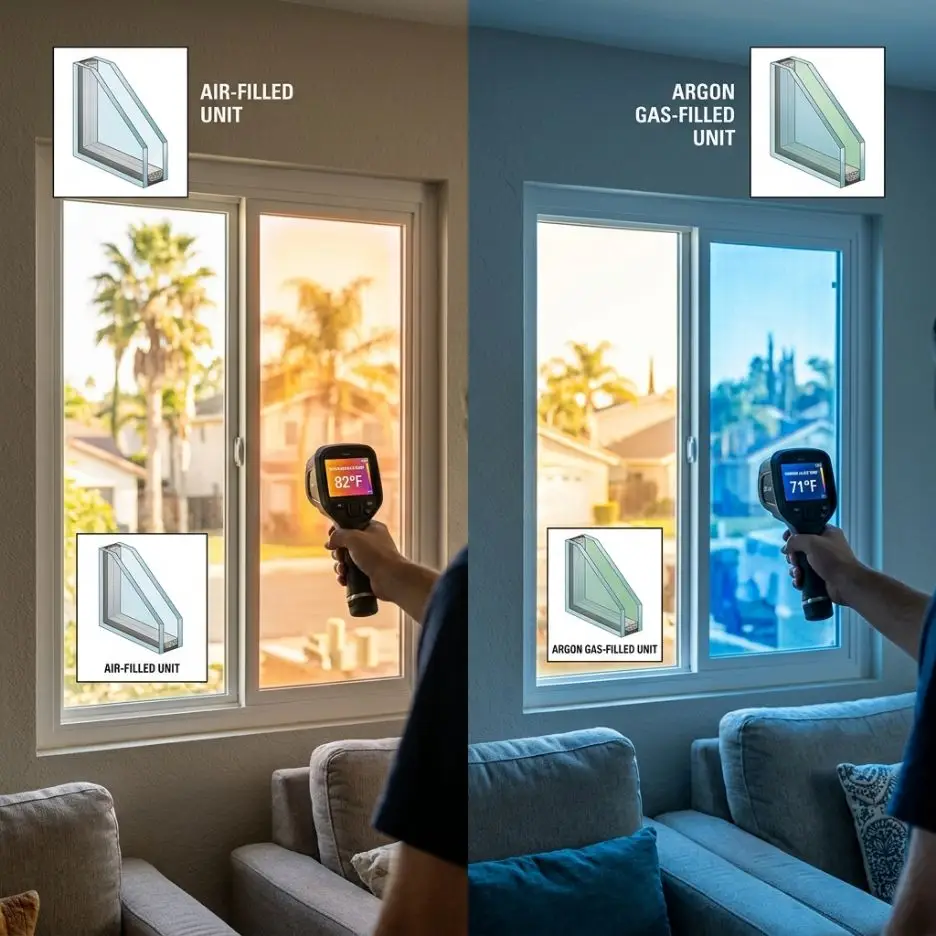
The space between two panes of glass is like a tiny insulation layer. If it’s just regular air, it conducts heat fairly easily. That means hot air from outside passes through the gap and radiates into your room. You feel warmer, your AC works harder, your bill climbs.
Fill that gap with argon instead, and the heat transfer slows down. Argon is denser and moves more slowly than air, so it insulates better. This matters most in Southern California where sun exposure is relentless. Whether you’re in Irvine dealing with coastal heat or in the Coachella Valley facing 120-degree summers, the window fill you choose directly impacts your comfort and cooling costs.
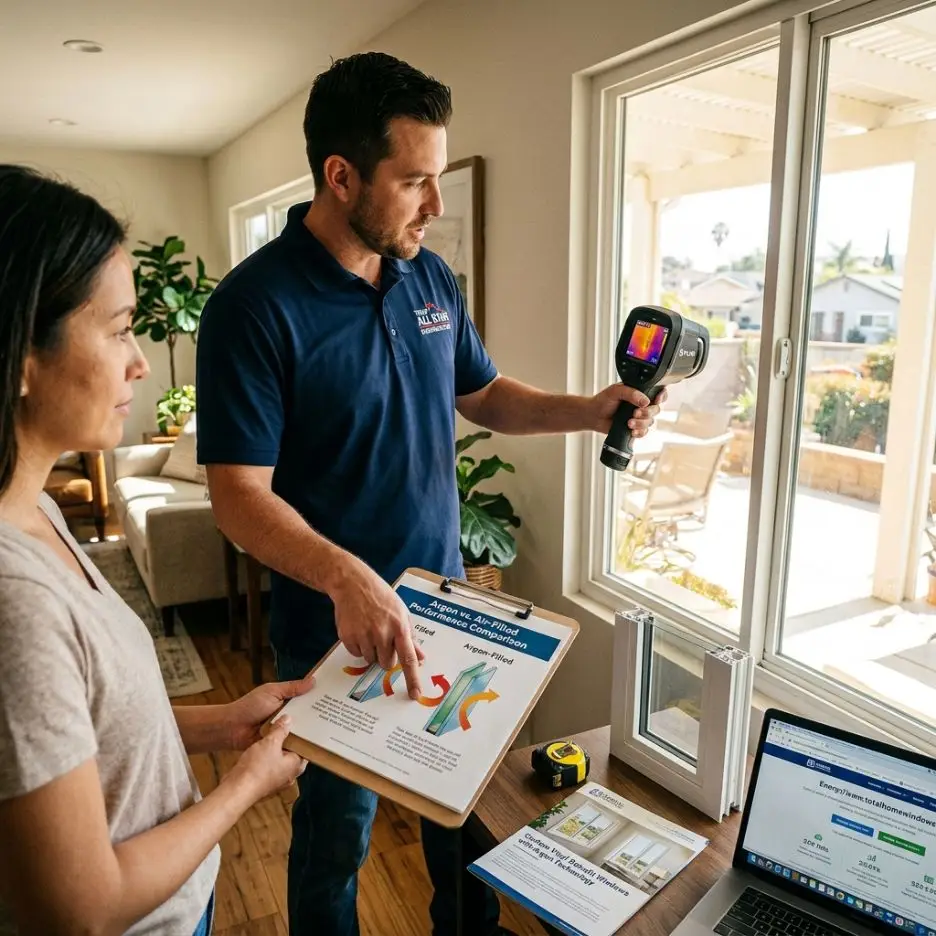
We measure this effect in your home during consultations. You’ll see the temperature difference between single-pane sections and modern insulated windows. That’s not theory—that’s what’s actually happening in your space.
Understanding Air-Filled Windows: Performance and Limitations
Standard double-pane windows use regular air between the glass. They work. They’re better than single pane. But air is a poor insulator—it conducts heat at a predictable rate, and in hot climates, that becomes expensive.
Air-filled windows made sense when energy costs were low and AC efficiency mattered less. Modern windows raise the bar considerably. Here’s what air-filled windows deliver:
- Basic insulation improvement over single pane
- No significant thermal barrier against extreme heat
- Limited value in high-sun environments like Southern California
- Acceptable for mild climates, not ideal for ours
The real limitation: air can move inside the sealed space, and it degrades over time. Seals wear, moisture enters, and the insulating value drops further. You end up paying to cool air that’s already hot.
How Argon Gas Windows Deliver Superior Thermal Efficiency
Argon is an inert noble gas—colorless, odorless, and significantly denser than air. It moves slower, which means heat transfer through the gas layer happens at a much lower rate. In a sealed window unit, this creates a meaningful insulation advantage.
Think of argon like a thicker blanket between the glass panes. Heat moving through the window has to work harder to traverse the gas layer. In Southern California’s intense sun, that small difference multiplies across every window in your home.
The science is straightforward: argon has a lower thermal conductivity value than air. Lower conductivity means less heat passes through. For homeowners, this translates to a cooler interior and a lower cooling load on your AC system. We’ve measured the difference in homes across Los Angeles County, Orange County, and the Inland Empire—the pattern is consistent.
Argon also doesn’t degrade like air does. It stays inert, so the insulating performance remains stable over decades. You’re not paying for protection that slowly disappears.
Argon vs. Air: Direct Performance Comparison
When we compare these options directly, the differences become clear:
Thermal Resistance (R-Value) Air-filled double pane: approximately R-1.8 to R-2.0 Argon-filled double pane: approximately R-2.4 to R-3.0
That 30-50% improvement in thermal resistance sounds modest until you multiply it across every window in your home.
Heat Transmission in Summer Air-filled windows allow steady heat transfer on hot days. The interior surface temperature of an air-filled window can be 10-15 degrees warmer than surrounding walls. Your AC works constantly to counteract this.
Argon-filled windows keep interior surface temperatures closer to wall temperature. Heat doesn’t radiate as intensely into your living space. You feel the difference in comfort, and your system runs less frequently.
Long-Term Performance Air gradually allows moisture infiltration and seal degradation. Argon remains stable indefinitely, provided the seal holds. This matters because window lifespan depends on seal integrity.
Financing may be available through third-party lenders for qualified applicants. Availability, APR, fees, down payment, and repayment terms depend on the lender and approval. Review the complete loan terms before accepting.
Why We Recommend Argon-Filled Solutions for Southern California Homes
Our region demands more from windows than temperate climates. You experience 300+ days of sunshine annually. Summer heat often exceeds 95 degrees inland, sometimes reaching 110+. Your cooling season runs longer than most of the country.
These conditions make argon-filled windows practical, not optional. Here’s why we consistently recommend them:
- Your AC already works hard; argon reduces that load meaningfully
- The investment pays back faster here than in cooler regions
- Seal failure matters less with inert gas—no degradation
- Comfort improvement is noticeable within weeks
We also consider your specific location. Homes in full-sun positions in Pasadena, Huntington Beach, or Victorville see faster payback on argon windows than homes with shade coverage. We assess your exposure during the in-home consultation and show you exactly where heat enters.
Every Southern California home is different. Older windows let heat through. South and west-facing glass takes the heaviest sun load. Argon addresses both problems. Air-filled windows miss the opportunity.
Custom Vinyl Retrofit Windows with Argon Technology
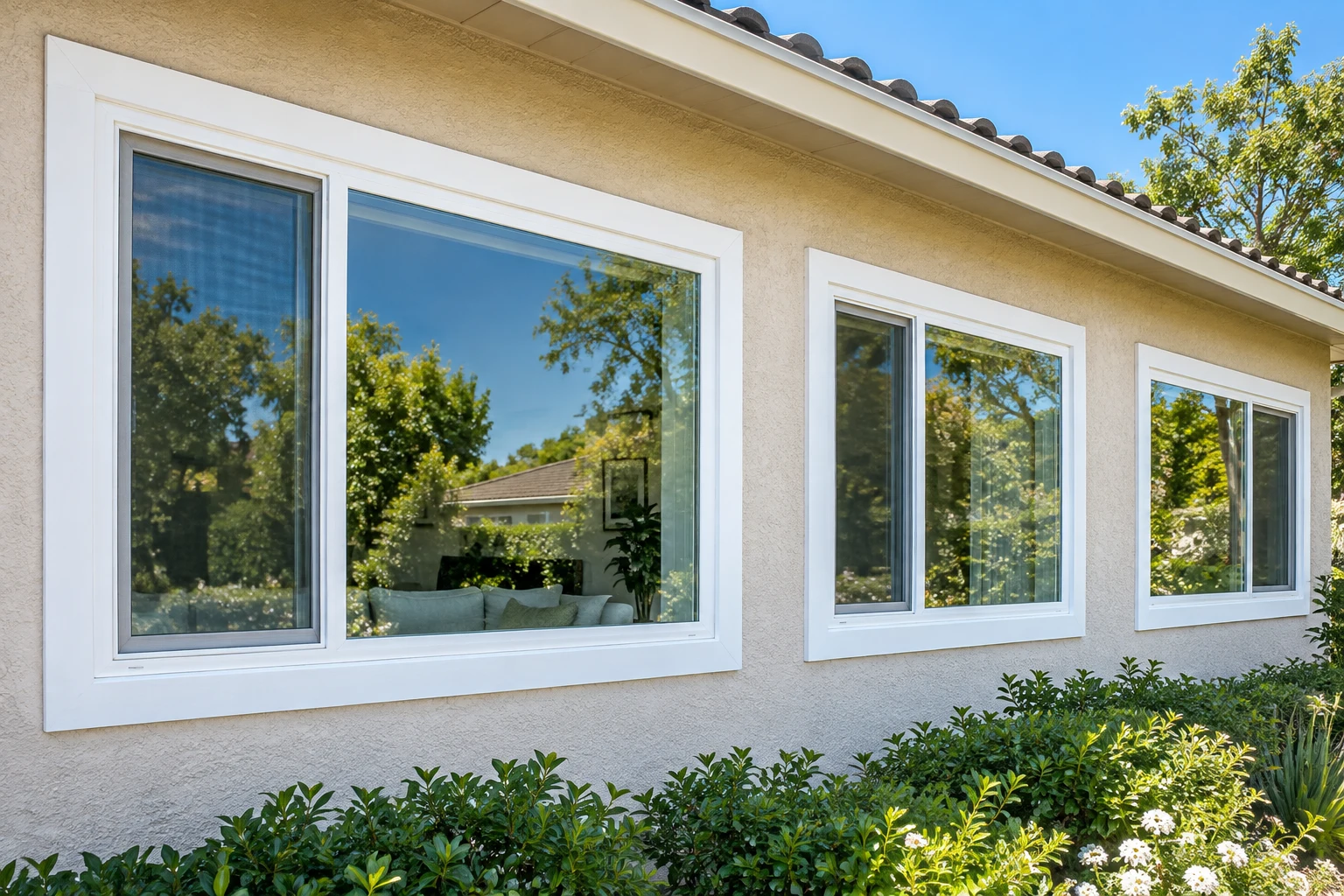
Our vinyl retrofit windows use argon fill as standard across our energy-efficient systems. Retrofit installation means we fit new windows into your existing frame opening without removing exterior stucco or siding. This approach is faster, cleaner, and costs less than full frame replacement.
The argon advantage works identically in retrofit windows. The sealed glass unit sits inside the new vinyl frame, and the argon layer insulates just as effectively. You get the thermal benefit without extensive exterior work.
We custom-measure every opening. No two homes are identical. Window widths, heights, and frame conditions vary. Custom sizing ensures a perfect fit and maximum seal integrity. A poor-fitting window loses performance quickly. Our precision approach prevents this.
The retrofit process takes a day or two per home. By evening, you’re living with cooler interior temperatures and lower AC runtime. No extended construction timeline.
Full Frame Replacement: Maximizing Argon Window Benefits
When frames are damaged, rotted, or extremely outdated, retrofit windows won’t work. Full frame replacement means we remove the entire old window assembly and install a new frame inside the opening. This approach suits homes where structural issues exist or where maximum performance matters most.
Full frame replacement gives us more control over the seal and installation. We remove all old material, inspect the opening, and install a new window system from scratch. Argon-filled glass in a properly seated frame performs at peak efficiency.
This method costs more than retrofit but delivers superior long-term results. The frame itself contributes to thermal performance. New vinyl frames have better insulation properties than frames from 10, 20, or 30 years ago. Combined with argon glass, you’re installing a complete modern system.
For homes in Anaheim, Santa Ana, or other older neighborhoods where many windows show age, full frame replacement often makes sense. You’re not compromising on performance or trying to work around damaged original frames.
Long-Term Savings and Energy Efficiency Gains
Argon-filled windows reduce cooling costs consistently across Southern California. The exact savings depend on several factors:
- Number of windows replaced
- Original window condition
- Your home’s sun exposure
- Thermostat settings
- Existing insulation levels
The payback timeline shortens with each year. If your retrofit costs $12,000 and delivers $2,000 annual savings, you’ve recovered the investment in six years. After that, the savings are pure benefit. You’re living more comfortably for the next 25-30 years with almost no additional cost.
Some homeowners qualify for energy efficiency rebates from utilities. Southern California Edison and other providers sometimes offset window upgrade costs. We discuss available incentives during your consultation.
Selection Guide: Which Window Type Solves Your Problem
Choose air-filled windows if:
- Your home has primarily interior shade
- Your cooling costs are modest
- You’re replacing windows as cosmetic upgrades
- Your budget is tight and you need the most affordable option
- You plan to sell within 3-5 years
Choose argon-filled windows if:
- Your home faces significant sun exposure (south or west walls)
- Summer cooling bills are a concern
- You plan to stay in your home 7+ years
- You want measurable comfort improvement
- You live in an inland or high-heat area of Southern California
For most of our Southern California clients, argon makes sense. The climate here drives consistent cooling demand. Argon delivers meaningful savings and comfort improvement that justifies the investment.
Getting Your Custom Argon Window Installation
When you’re ready to understand exactly how much heat enters your home and what will actually fix it, we start with an in-home consultation. We measure your current windows, assess sun exposure, check frame conditions, and discuss your cooling concerns.
During this visit, we show you the problem directly. You’ll see the temperature difference between old windows and modern alternatives. You’ll understand why certain areas of your home feel warmer. We walk through argon performance versus air-filled options using real numbers from your space.
No pressure. No sales tactics. Just clear answers about what’s happening and what solves it best.
We serve homes throughout Los Angeles, Orange, Ventura, San Bernardino, and Riverside counties. Whether you’re in West Hollywood, Irvine, Temecula, or Palm Springs, we’ve installed argon-filled windows and measured the performance improvement.
Your home is hot because heat enters through windows. Window upgrades in SoCal with argon-filled glass reduce that heat transfer meaningfully. Schedule your consultation, and we’ll show you exactly what’s possible for your home.
Get a free estimate for your home. No pressure—just clear answers and straightforward pricing. Call (310) 729-3013 or visit: https://teamallstarconstruction.com/contact/
Frequently Asked Questions (FAQ)
How much can I save by upgrading to argon-filled windows?
We typically see Southern California homeowners reduce their cooling costs by 10-15% annually when switching from air-filled to argon windows, though your exact savings depend on your current windows’ condition and your home’s size. Since we’re located in a hot climate where air conditioning runs year-round, argon’s superior insulation translates directly to lower utility bills. Most of our clients recoup their investment within 5-7 years through energy savings alone.
Do argon windows work well in our Southern California climate?
Absolutely. We specifically recommend argon-filled solutions for Southern California homes because argon gas resists the heat transfer that air allows, which is exactly what you need in our warm, sunny climate. Our retrofit and full-frame replacement options are manufactured with argon technology tailored to regional temperature swings and intense UV exposure. This is why we’ve made argon our default recommendation across Los Angeles, Orange, San Bernardino, Riverside, and Ventura counties.
What’s the difference between vinyl retrofit and full-frame replacement windows?
With our vinyl retrofit option, we install new windows inside your existing frame, which works well if your current frames are solid and you want a faster installation. Full-frame replacement removes the entire old window system and lets us seal everything properly from the outside in, which maximizes argon performance and is our preferred approach for older homes or frames with damage.
We’ll assess your situation during our in-home consultation and recommend whichever approach delivers the best long-term results for your home.
- Categories: Window Testing & Performance Guides
- Tags: argon vs air windows, energy efficient glass comparison, gas filled vs air windows, heat reduction windows, insulated glass units comparison, window efficiency, window insulation comparison, window performance difference
Southern California Window Replacement Guide
Single Pane vs Dual Pane: Which Fits Your Home?
Replacement Windows Los Angeles Homeowners Choose
Retrofit Windows vs Full Frame: Which Fits?
A Guide to Full Window Replacement at Home
Vinyl vs Aluminum Windows for Southern California
Best Windows for Hot Climates in Southern California
A Homeowner’s Guide to Energy Efficient Windows
How to Reduce Window Heat at Home
About Total Home Windows
Total Home Windows is a Southern California-based window replacement company focused on helping homeowners improve energy efficiency, indoor comfort, and long-term home value through high-performance window installations.
Serving Los Angeles County, Orange County, Riverside County, San Bernardino County, and Ventura County, the company specializes in both vinyl retrofit (insert) and full-frame window replacement. Their work is tailored to the unique demands of California homes, including intense UV exposure, coastal conditions, and heat retention issues common in older properties.
Total Home Windows combines practical installation experience with a strong focus on energy performance—helping homeowners reduce cooling costs, improve insulation, and solve common problems like rooms that stay hot even with air conditioning. Their approach prioritizes clear recommendations, transparent pricing, and solutions that make sense for each home.
The content published by Total Home Windows is built on real installation knowledge, field-tested performance insights, and current best practices in window technology, including Low-E glass, argon-filled units, and energy-efficient design strategies. Their goal is to help homeowners make informed decisions without overpaying or choosing the wrong type of window system.
Ways to Reach Us
If you’re considering window replacement, we’re here to answer questions and provide clear, professional guidance based on your home and goals.
- teamallstarconstruction@gmail.com
- 301 E.9th St Suite 415 Redlands, CA 92374