Prices and performance figures in this guide are planning examples, not a project quote or a promise of savings. Your estimate and results depend on the products, installation scope, existing home, climate, and energy use.
Why Homeowners Miss Hidden Heat Leaks with DIY Methods
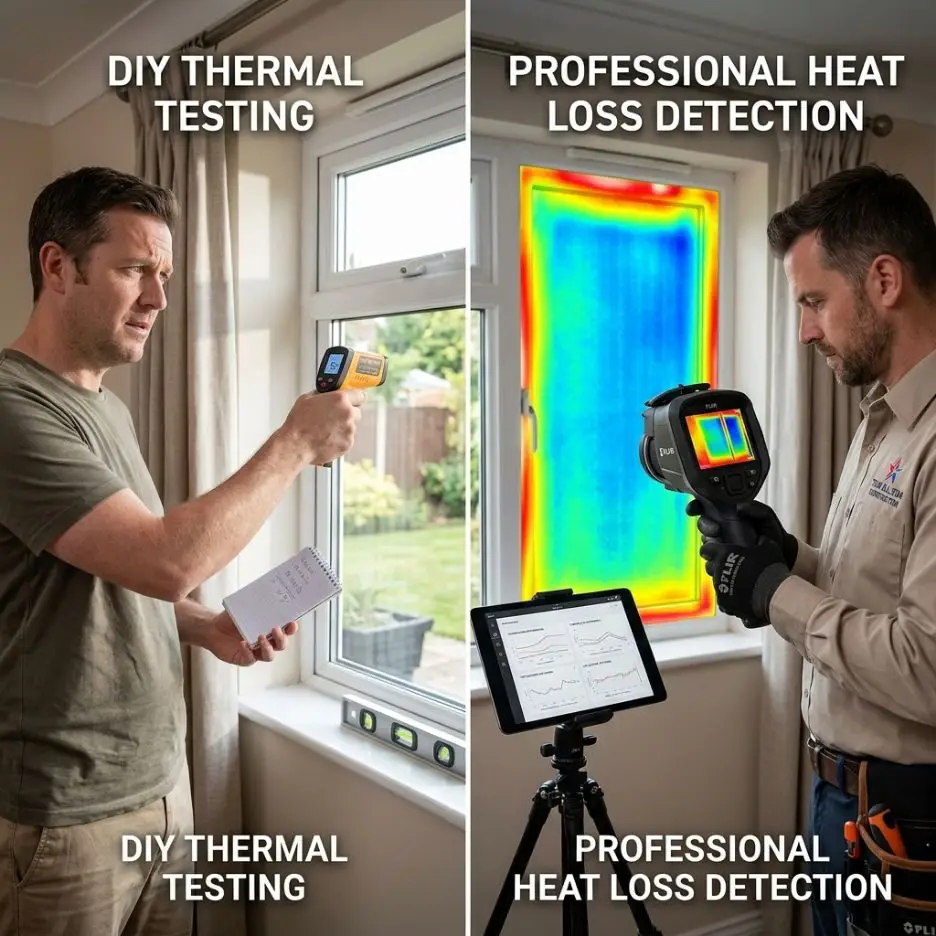
Your home feels hot even with the AC running. You suspect your windows, but you’re not sure if they’re actually the problem or how bad it really is. That’s where thermal window testing comes in. The question isn’t whether your windows need inspection—it’s whether you should try to measure the problem yourself or get professional data that shows exactly what’s happening.
We’ve seen homeowners spend hours with infrared thermometers and felt drafts, only to make expensive decisions based on incomplete information. Meanwhile, others skip testing entirely and guess at solutions. Neither approach works. Here’s what actually separates DIY attempts from professional heat loss detection, and why it matters for your wallet and comfort.
Most homeowners don’t realize that heat enters your home through multiple pathways at once. You might feel a draft near one window frame and assume that’s the main problem. But air leakage, solar heat gain, conduction through the glass, and thermal bridging at the frame all contribute differently depending on time of day, sun angle, and outside temperature.
DIY approaches miss this complexity. A basic thermometer tells you a surface is hot, not why it’s hot or how much energy is actually being lost. You can’t see thermal bridging where metal frames conduct heat into your walls. You won’t detect air leakage that happens behind drywall or at seals you can’t access. And you definitely can’t quantify how much heat is entering versus how much your AC is struggling to remove it.
The real problem: you’re working with your senses and basic tools instead of equipment designed to map heat distribution and measure thermal performance. This leads to incomplete diagnoses and decisions based on guesswork rather than data.
What to do next: Before you invest in new windows, get a complete picture of where heat is actually entering your home. That means more than checking surface temperature—it means measuring performance holistically.
How DIY Temperature Checks Fall Short of Real Data
Holding an infrared thermometer to your window and reading 95 degrees feels like useful information. But it doesn’t tell you whether that temperature is normal for the conditions, whether it’s caused by outside heat or air leakage, or how your window’s performance compares to modern energy-efficient standards.
Here’s the gap: temperature readings are snapshots in time. Your window might read hot at 2 PM because the sun is beating directly on the glass (normal) and cool at 6 PM because the sun has moved (also normal). Without context, these readings don’t reveal performance issues. Professional heat loss detection methods account for outside temperature, inside conditions, humidity, solar intensity, and time of measurement to give you meaningful comparisons.
DIY methods also can’t measure what’s happening inside the wall cavity or between glass panes. You’re only seeing surface temperature, not the actual thermal resistance (R-value) or how well the window is insulating. A window that looks hot on the outside might actually be performing as designed—or it might be failing in ways you can’t detect.
Additionally, infrared thermometers can be fooled by reflective surfaces, emissivity variations, and angle of measurement. Small errors compound when you’re trying to compare windows or track changes over time.
What to do next: Stop relying on single-point temperature readings. Instead, gather data that shows the complete thermal profile of your windows under different conditions.
What Professional Thermal Testing Actually Measures
Professional thermal testing goes beyond “how hot is it.” We measure thermal performance by examining heat flow, temperature differentials, air leakage patterns, and overall window efficiency under real-world conditions.
When we conduct thermal testing, we’re looking at:
- Temperature differentials across the window assembly – the difference between inside glass surface and outside glass surface tells us about insulation effectiveness
- Thermal bridging patterns – where frames and muntins conduct heat into the home
- Air leakage zones – gaps and seals that allow hot air to infiltrate
- Solar heat gain characteristics – how much heat the glass absorbs versus reflects
- Moisture and condensation patterns – indicators of seal failure or condensation risk
We also measure these factors under consistent conditions and against baseline standards. This gives us real performance data, not just surface observations. We can tell you exactly how much heat is entering through each window, where the worst performers are, and what replacement specifications will solve the problem.
The testing process captures the full picture of your window system’s performance, accounting for how it behaves during peak heat hours and under the specific climate conditions of Southern California.
Our Advanced Thermal Imaging Process Explained
Our thermal assessment uses infrared imaging technology combined with environmental monitoring. Here’s how it works in your home:
We start by documenting baseline conditions: outside temperature, inside temperature, humidity, sun angle, and time of day. These variables matter because they change how your windows perform. A window that performs adequately in winter might be a major heat source in summer.
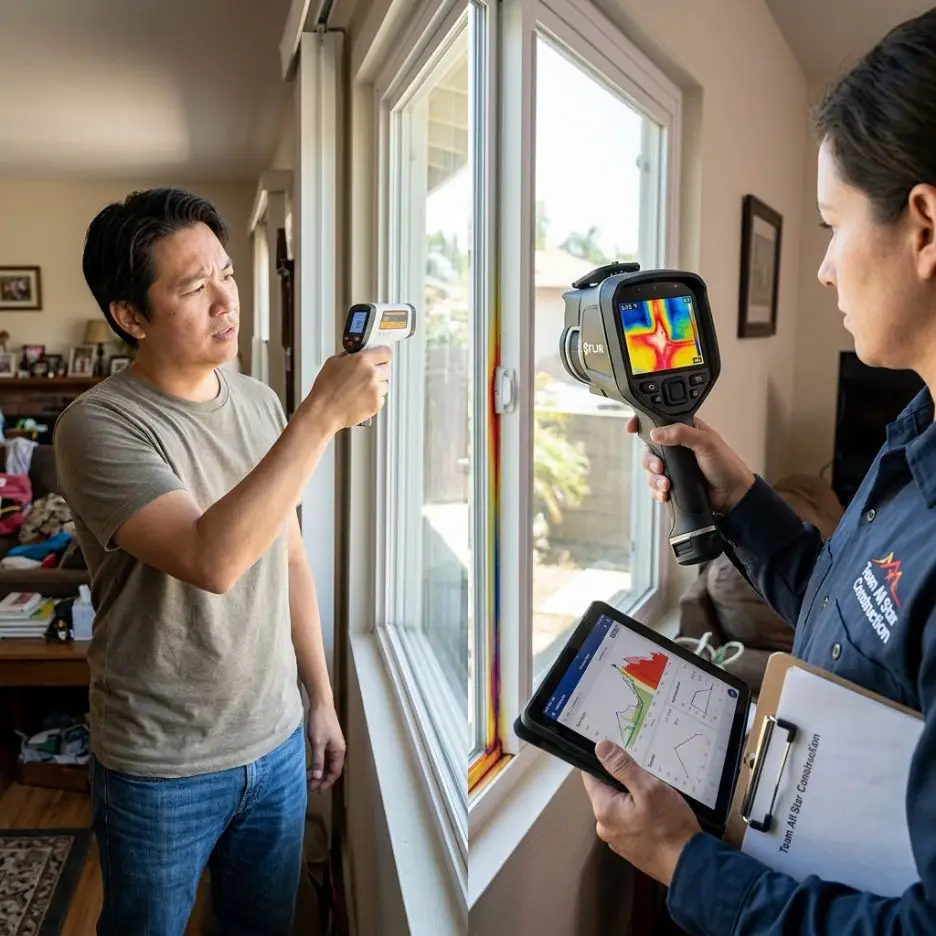
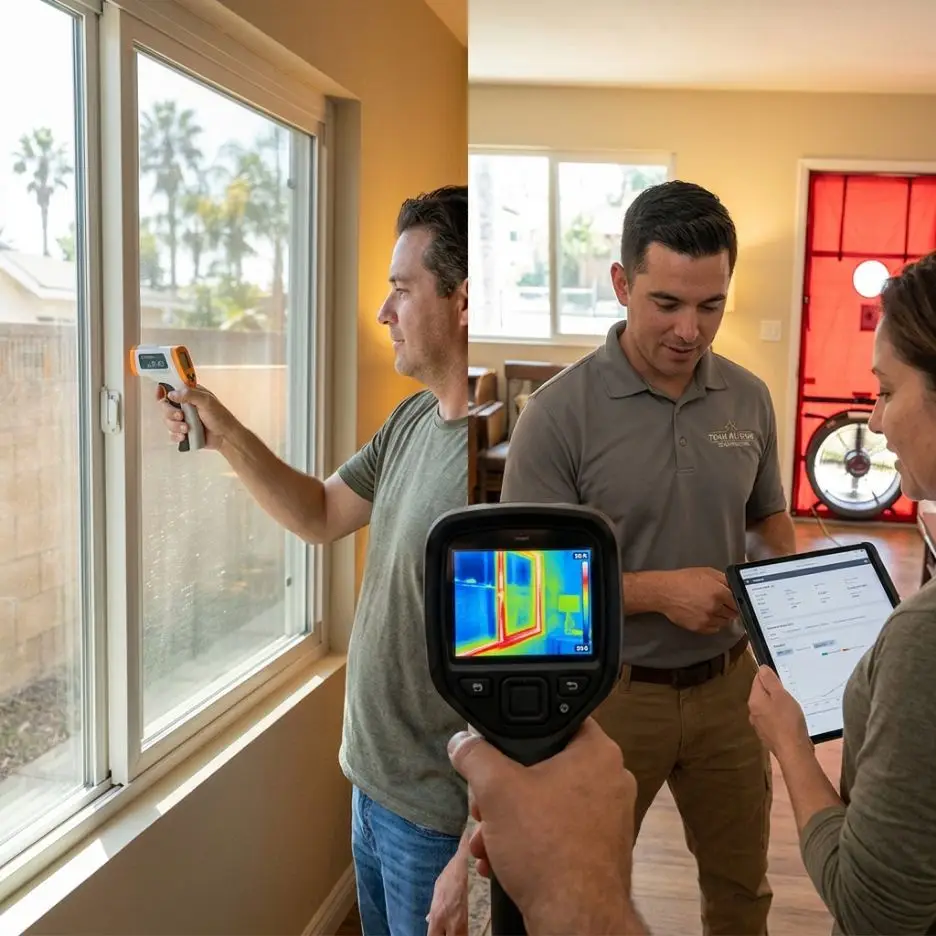
Next, we use calibrated thermal imaging cameras to capture heat distribution across your windows and surrounding walls. The camera shows us exactly where temperature variations exist and reveals patterns you can’t see with your eyes. Thermal images make heat leaks visible. You can see the hot spots where heat is entering, the cold spots where insulation is weak, and the thermal bridging where frame materials are conducting heat.
We take multiple images from different angles and at different times if needed to build a complete thermal profile. We also measure actual temperature differentials using precision instruments, not just visual interpretation.
Then we analyze the data against your window’s specifications and performance standards for your climate zone. We can compare your current windows to modern energy-efficient alternatives and show you exactly what improvement you’ll see.
The result: a detailed thermal assessment report that shows the problem, quantifies it, and proves what the solution will deliver. You’re not guessing anymore—you have proof.
Accuracy and Reliability: Professional Testing vs DIY Attempts
Here’s the core difference: professional thermal testing is repeatable and verifiable. If we measure a window and find specific performance issues, another certified technician using the same process would reach the same conclusion. DIY measurements often can’t meet this standard.
Professional equipment is calibrated to accuracy standards. Our thermal cameras are regularly checked and maintained to ensure readings are reliable. We document conditions consistently so comparisons are meaningful. When we tell you a window is losing X amount of heat, that number is based on standardized measurement, not interpretation.
DIY thermometers have accuracy tolerances too, but they’re typically wider and they don’t account for the environmental factors that affect thermal readings. More importantly, DIY efforts lack the training to interpret what the numbers actually mean for your home’s performance.
Reliability also comes from experience. We’ve tested thousands of windows across Southern California. We know how vinyl windows, aluminum frames, single-pane glass, and double-pane systems actually perform in the heat. We can spot patterns you wouldn’t recognize and predict failure points before they become obvious.
When you need to make a decision about replacing windows, you’re making it based on accurate data, not guesswork. That accuracy translates directly to better choices and better results.
What to do next: Choose thermal testing from someone who can back up their findings with standard methodology and verifiable data.
Cost Savings You Uncover with Proper Heat Loss Identification
Accurate heat loss identification saves you money in two immediate ways: you avoid replacing windows that don’t need replacement, and you prioritize replacements that will make the biggest difference.
Here’s a real scenario: a homeowner in Pasadena notices their west-facing living room is extremely hot in the afternoon. They assume all their windows are failing and budget $15,000 for complete window replacement. But our thermal assessment shows that three west-facing windows are actually the problem—the others are performing adequately. They replace just those three with high-performance vinyl windows and get 80% of the improvement for 40% of the cost.
Proper testing also reveals whether air conditioning efficiency is the real issue or window performance. Sometimes a window feels hot because the AC unit is undersized or poorly positioned, not because the window is failing. You’d waste money replacing windows when the real fix is different. Our thermal assessment shows this distinction.
Over time, the cost savings compound. Energy-efficient window replacement targets the actual heat sources in your home, which means your AC runs more efficiently, your energy bills drop further, and you’re not paying to replace windows that were already working.
Many homeowners also discover that phased replacement makes sense. Replace the worst performers first, measure the improvement, then decide about the rest. That’s only possible when you have precise data about which windows are actually the problem.
What to do next: Get a professional heat loss assessment before committing to any window replacement budget. You might spend less than you thought and still solve the problem completely.
How Our Findings Lead to the Right Window Solution
Our thermal assessment doesn’t just identify problems—it guides you to the right solution for your specific situation. Not all windows are the same, and not all homes need the same performance upgrade.
After we complete thermal imaging and testing, we walk you through exactly what we found. We show you the thermal images, explain what they mean, and discuss which windows are the priority. Then we talk about window specifications that will address those problems.
For a home with extreme solar heat gain on west-facing walls, we might recommend low-emissivity (low-E) glass that reflects solar heat while still allowing visible light. For areas with older single-pane windows, we recommend double or triple-pane glass with insulated frames. For homes with air leakage around frames, we discuss professional installation that seals air gaps properly.
Our thermal assessment data lets us specify exactly which window performance characteristics will solve your problem. You’re not choosing windows based on brand names or generic “energy-efficient” labels. You’re choosing based on measured performance requirements in your home.
This is why window replacement options matter—the right solution depends on your specific thermal profile, your climate zone within Southern California, and your comfort goals. We help you understand that connection so your investment delivers the results you need.
Why We Stand Behind Our Thermal Assessment Results
We back our thermal assessments because we stake our reputation on accuracy. If our testing shows that specific window replacements will reduce heat gain by 40%, and you see a different result after installation, we want to know about it. That’s how we stay rigorous.
Our process is documented. We provide you with a detailed report that includes thermal images, temperature measurements, solar heat gain calculations, and performance projections. If you want a second opinion, you have the data to show another professional. That transparency matters.
We also follow up with customers after window replacement to confirm that the thermal improvement we projected actually materialized. This feedback loop keeps us accountable and helps us refine our recommendations for future assessments.
The reason we can stand behind our results: we use calibrated equipment, follow standard testing protocols, and rely on data—not opinions. We measure what’s happening in your home and show you proof.
Taking Action: From Testing to Energy-Efficient Replacement
Once you understand your home’s thermal profile, the path to resolution becomes clear. You know which windows to replace first. You know what performance specifications will solve the problem. And you can plan your budget intelligently.
The typical timeline looks like this:
1. Schedule a professional thermal assessment at your home (no cost, no pressure to buy anything)
2. Review the thermal imaging report and discussion with our team
3. Discuss energy efficient window upgrades that match your specific needs
4. Plan replacement timeline and budget (often phased based on priority)
5. Professional installation with attention to proper sealing and thermal performance
6. Follow-up to confirm improved comfort and energy efficiency
During installation, we focus on the details that our thermal assessment identified. If testing showed air leakage around the frame, we ensure the new installation seals those gaps. If solar heat gain was the issue, we install the right glass specification. Every decision is informed by the thermal data we gathered about your home.
The end result: you’re not guessing whether the work will help. You already know it will, because we measured the problem and designed the solution around that data.
Why Guessing About Your Windows Costs You Money
Every week we meet homeowners who have spent thousands on window replacements that didn’t fully solve their comfort problem. Not because the windows were low quality, but because they were the wrong windows for the actual heat source in that home.
One homeowner in Long Beach replaced all their windows with mid-range energy-efficient models based on a contractor’s recommendation. The house still felt hot. Our thermal assessment showed that while the windows were good, the real problem was inadequate insulation in the roof and exterior walls. The window replacement helped—but addressing the roof issue would have given 10 times the improvement.
Another homeowner in Irvine kept their older windows because they didn’t think the problem was that serious. Meanwhile their energy bills climbed every summer. A simple thermal assessment would have shown them exactly how much heat was entering through outdated single-pane glass and made the business case for replacement obvious.
Guessing costs money because you make decisions without complete information. You might:
- Replace windows that don’t need replacement while ignoring ones that do
- Choose the wrong window type for your climate and heat pattern
- Miss opportunities for phased replacement that spreads cost over time
- Overlook other heat sources that are actually worse than windows
- Invest in improvements that deliver less benefit than you expected
Professional thermal testing eliminates guesswork. You make decisions based on measured heat loss, not assumptions. That’s worth the small investment in assessment because it guides thousands of dollars in window replacement decisions.
The reason we emphasize thermal testing: honest diagnosis leads to better solutions and better outcomes. You deserve to know what’s actually happening in your home before you invest in fixing it. That’s exactly what our thermal assessment provides.
If your home feels hot even with the AC running, or if your energy bills keep climbing, thermal testing will show you why. We’ll walk you through the findings, explain what you’re looking at, and discuss whether window replacement is the answer—and if so, exactly which windows matter most. No pressure, just clear answers based on data from your home.
- Categories: Window Testing & Performance Guides
- Tags: DIY window testing, heat loss detection windows, home energy audit windows, professional window inspection, thermal imaging vs DIY, thermal performance testing, window diagnostics, window efficiency testing
Southern California Window Replacement Guide
Single Pane vs Dual Pane: Which Fits Your Home?
Replacement Windows Los Angeles Homeowners Choose
Retrofit Windows vs Full Frame: Which Fits?
A Guide to Full Window Replacement at Home
Vinyl vs Aluminum Windows for Southern California
Best Windows for Hot Climates in Southern California
A Homeowner’s Guide to Energy Efficient Windows
How to Reduce Window Heat at Home
About Total Home Windows
Total Home Windows is a Southern California-based window replacement company focused on helping homeowners improve energy efficiency, indoor comfort, and long-term home value through high-performance window installations.
Serving Los Angeles County, Orange County, Riverside County, San Bernardino County, and Ventura County, the company specializes in both vinyl retrofit (insert) and full-frame window replacement. Their work is tailored to the unique demands of California homes, including intense UV exposure, coastal conditions, and heat retention issues common in older properties.
Total Home Windows combines practical installation experience with a strong focus on energy performance—helping homeowners reduce cooling costs, improve insulation, and solve common problems like rooms that stay hot even with air conditioning. Their approach prioritizes clear recommendations, transparent pricing, and solutions that make sense for each home.
The content published by Total Home Windows is built on real installation knowledge, field-tested performance insights, and current best practices in window technology, including Low-E glass, argon-filled units, and energy-efficient design strategies. Their goal is to help homeowners make informed decisions without overpaying or choosing the wrong type of window system.
Ways to Reach Us
If you’re considering window replacement, we’re here to answer questions and provide clear, professional guidance based on your home and goals.
- teamallstarconstruction@gmail.com
- 301 E.9th St Suite 415 Redlands, CA 92374