
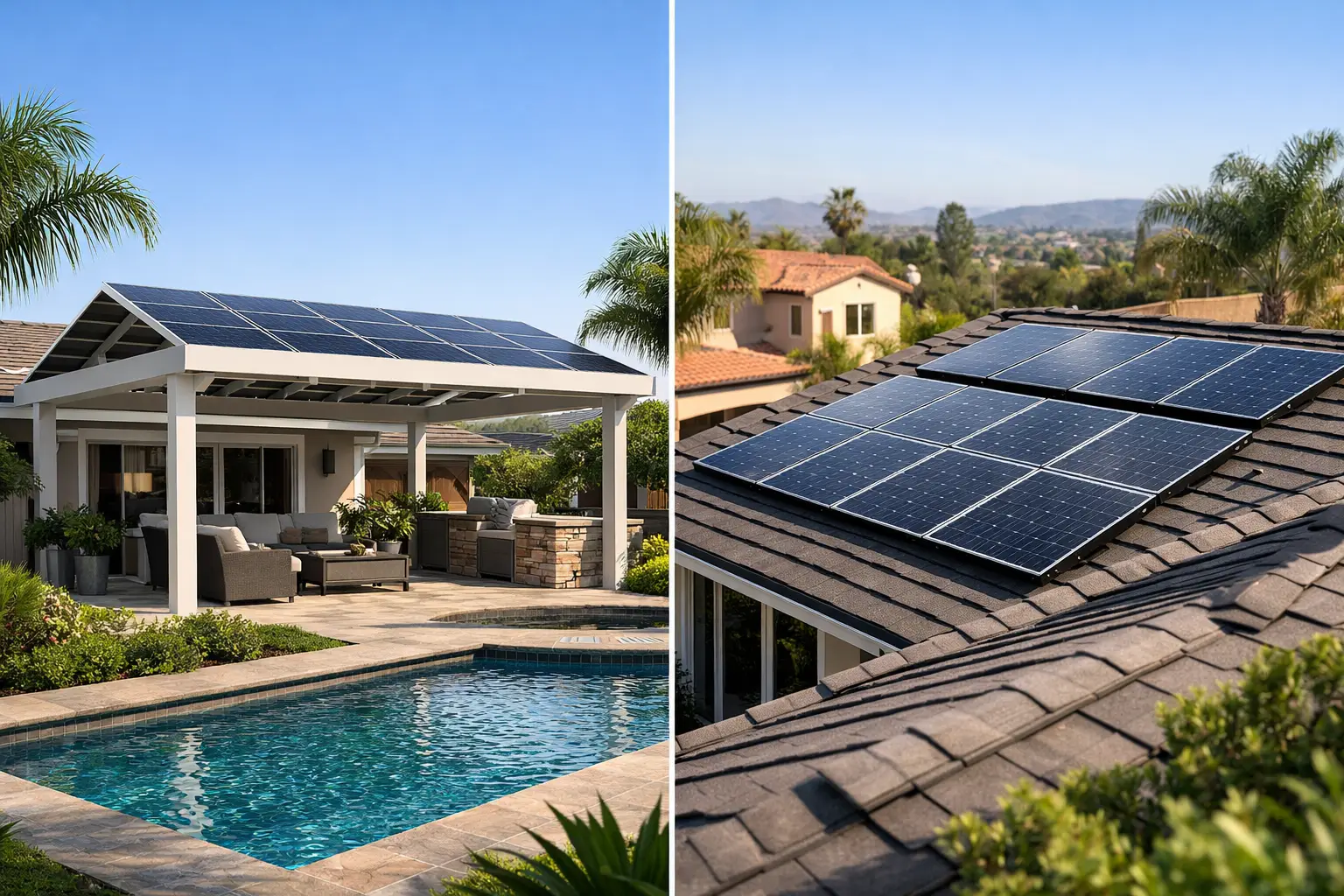
If your roof is crowded, shaded, aging, or simply off-limits in your mind, the solar pergola vs rooftop solar decision is not just about panel placement. It is really a choice between two different home improvement strategies – one that adds power to your roof, and one that adds power, shade, and usable outdoor living space at the same time.
For many Southern California homeowners, that distinction matters. In places where backyards are used nearly year-round, a solar pergola can solve more than one problem in a single project. Rooftop solar still makes sense in many cases, but it is not the only smart path to lower utility bills and more energy independence.
Solar pergola vs rooftop solar: the short answer
Rooftop solar is often the more direct option if your roof has strong sun exposure, enough available space, and a layout that works well for panel placement. It uses an existing surface, so you are adding energy production without building a new structure.
A solar pergola is often the better fit when you also want shade, outdoor comfort, a new patio cover, or an alternative to mounting panels on your home. It can be especially appealing for homeowners with tile roofs, older roofs, limited roof space, complicated rooflines, or strong preferences about curb appeal.
Neither option is automatically better. The right choice depends on your roof condition, your backyard goals, your energy needs, and whether you want solar to be a standalone upgrade or part of a larger outdoor living investment.
What makes a solar pergola different
A rooftop solar system is exactly what most homeowners picture – panels attached to the home’s roof to generate electricity. A solar pergola, by contrast, is a purpose-built shade structure designed to support solar panels while creating a functional outdoor area below.
That difference changes the value equation. A rooftop system is mainly an energy project. A solar pergola can be an energy project and an outdoor living project. It may help support lower power costs, but it also creates a shaded area for dining, lounging, entertaining, or covering an outdoor kitchen.
That is why many homeowners see it as The Patio Cover That Pays You Back™. Instead of paying separately for a patio cover and later paying for solar, they combine both into one design.
When rooftop solar usually makes more sense
Rooftop solar tends to be the practical choice when the roof is already well suited for solar and the homeowner does not need a new shade structure. A newer roof with good orientation, minimal shading, and enough square footage can often support an efficient panel layout.
It can also be the simpler visual choice if you prefer to keep your backyard unchanged. If your main goal is generating electricity and your roof can do the job well, rooftop solar remains a strong option.
In some homes, it may also allow for higher production simply because the available roof area is larger than what a patio cover footprint would provide. That said, actual output depends on panel count, sun exposure, tilt, orientation, and site conditions. Bigger is not always better if part of the roof is shaded or broken up by vents, ridges, or multiple angles.
When a solar pergola pulls ahead
A solar pergola becomes especially attractive when your roof is not ideal or when you want the project to improve daily living, not just energy performance. Many Southern California homes have roofs with design constraints that make solar more difficult than homeowners expect. The issue may be limited south- or west-facing space, older roofing materials, nearby trees, second-story shade patterns, or simply not wanting hardware mounted overhead.
In those cases, a pergola can offer a cleaner solution. It creates a dedicated structure designed around both solar production and backyard use. That means the layout can be planned with intent instead of working around roof obstacles.
It also adds shade where people actually feel it. In hotter inland areas such as Riverside County or San Bernardino County, that can make a major difference in how often a patio gets used. In coastal and HOA-sensitive neighborhoods, the design side can matter just as much. Some homeowners are comfortable seeing panels over a well-designed patio cover but do not want them across the front or main slopes of the home.
Cost is not a simple apples-to-apples comparison
This is where many comparisons go sideways. If you compare rooftop solar to a solar pergola based only on solar system cost, rooftop solar will often appear less expensive because the roof already exists. You are paying for the solar installation, not a new structure.
But that is not always the right comparison. If you already plan to build a patio cover, pergola, or outdoor shade structure, then the better question is whether it makes sense to combine that investment with solar. In that scenario, a solar pergola is not competing only with rooftop solar. It is competing with the cost of building a patio cover plus the cost of adding solar separately later.
For homeowners who need both, one integrated project can be more logical from a design, permitting, and planning standpoint. It can also reduce the hassle of coordinating multiple contractors for separate scopes of work.
Design, appearance, and home value considerations
Rooftop solar is more concealed from backyard living areas, but it is still highly visible on many homes. For some homeowners, that is no issue at all. For others, especially those with carefully maintained architecture or HOA concerns, appearance carries real weight.
A solar pergola gives solar a more intentional look because the structure is designed to support it from the start. Instead of panels appearing added onto an existing roof, they become part of a finished outdoor feature. That can feel more cohesive, particularly in homes where the backyard is a major living zone.
As for home value, both options may appeal to future buyers, but for different reasons. Rooftop solar may signal lower operating costs. A solar pergola may offer that same benefit while also presenting a usable shaded space that buyers can immediately see and enjoy. The exact value impact depends on design quality, neighborhood expectations, and how well the project fits the property.
Installation and project coordination
One of the least discussed parts of the solar pergola vs rooftop solar question is project complexity from the homeowner’s perspective. A traditional rooftop solar job is often handled by one solar company. A standard patio cover is often handled by a separate contractor. If you want both, coordination can quickly become your job.
That is where an integrated approach stands out. When the structure and solar system are designed together, the project can be planned as one finished result rather than two disconnected upgrades. That matters for layout, engineering, permitting, electrical planning, and overall appearance.
Homeowners often start by saying they want solar, then realize they also need shade. Others start by wanting a patio cover and later realize the roof is not their preferred place for panels. Combining the two early usually leads to a better outcome than trying to retrofit one around the other.
Which option produces more energy?
Sometimes rooftop solar wins this category. Sometimes a solar pergola does. It depends.
If your roof has excellent sun exposure and enough usable area, rooftop solar may support more panels and higher production. If your roof is chopped up, shaded, or poorly oriented, a well-placed pergola can sometimes be the more effective solar platform.
The key is usable solar real estate, not just total square footage. A clean rectangular patio cover area can be easier to design around than a roof interrupted by valleys, hips, vents, skylights, and setbacks. Production estimates should always be based on your actual property rather than a generic assumption.
Best fit by homeowner type
If you have a newer roof, good sun exposure, and no real need for added backyard shade, rooftop solar is often the straightforward choice. If your main goal is offsetting electricity use with the least structural change, that path may be enough.
If you want solar but not on your roof, need a new patio cover, are planning an outdoor kitchen or entertaining area, or want to turn an underused patio into a more comfortable space, a solar pergola usually deserves serious consideration. It is also a strong option for homeowners trying to combine shade, battery backup readiness, EV charging readiness, and long-term property improvement into one project.
For many Southern California homes, the answer is not just about where panels fit best. It is about where home life happens. When your backyard functions as a real extension of the house, a solar pergola can do something rooftop solar cannot – make the space better every day while it generates power overhead.
That is why this decision should start with how you want to live, not just where the panels go.