
A solar patio cover can create shade, support solar panels, and help prepare your home for electric vehicle charging as part of one coordinated energy plan.
Electric vehicles are changing the way homeowners think about energy. The question is no longer only where to park the car. It is also where the power should come from, how the home should be prepared, and whether solar can be added without placing panels on the main roof.
A solar patio cover gives homeowners another option.
Instead of treating a patio cover, solar panels, EV charging, and battery backup as separate upgrades, the project can be planned together from the start. The structure creates shade below. The panels above may support solar production. The electrical planning can also account for EV charging readiness, battery backup options, and future energy needs.
Plan My Solar Patio Cover Call (310) 729-3013 Solar Patios By Design™ is operated by Team All Star Construction, CSLB #1009760. Direct AnswerCan A Solar Patio Cover Be Used For EV Charging?
Yes. A solar patio cover may be planned to support EV charging when the solar system, electrical design, charger location, utility connection, and project scope are properly coordinated. The solar panels on the patio cover do not usually plug directly into the vehicle in a simple one-to-one setup. In most residential projects, the solar system connects into the home’s electrical system. The EV charger then draws power based on the electrical design, solar production, grid connection, battery storage if included, and how the system is configured. That means the real opportunity is not just “solar panels above the patio.” The bigger opportunity is a smarter home energy plan.
A solar patio cover can help homeowners think through:
- Where solar panels should go
- Where the EV charger should be located
- How the patio cover can support shade, solar, and long-term energy use
- Whether the main roof is the right place for solar
- Whether the electrical panel needs review
- Whether battery backup should be considered
- Whether conduit, wiring, and future EV readiness should be included early
The right design depends on the home, the vehicle, the charger, the solar system, the electrical panel, energy usage, battery plans, and local requirements.
Get My Solar Patio Cover Estimate More About Solar Patio CoversElectric Vehicles Make Home Energy Planning More Important
An electric vehicle can become one of the larger electrical loads in a home. That does not mean every EV owner needs a major solar project, but it does mean the home’s electrical plan matters more.
A homeowner who drives an EV may need to think about:
- Where the charger will be installed
- Whether the electrical panel has enough capacity
- Whether a Level 2 charger is desired
- How often the vehicle will be charged at home
- How many miles are driven each week
- Whether charging will happen during the day or overnight
- Whether solar production can help offset some charging usage
- Whether battery backup should be considered
- Whether future vehicles may increase energy demand
A solar patio cover brings these questions into the design conversation early. Instead of adding a patio cover now, solar later, EV charging later, and battery backup even later, the project can be reviewed as a connected system.
That is where the value is.
One contractor • One design • Coordinated permitting • One finished project
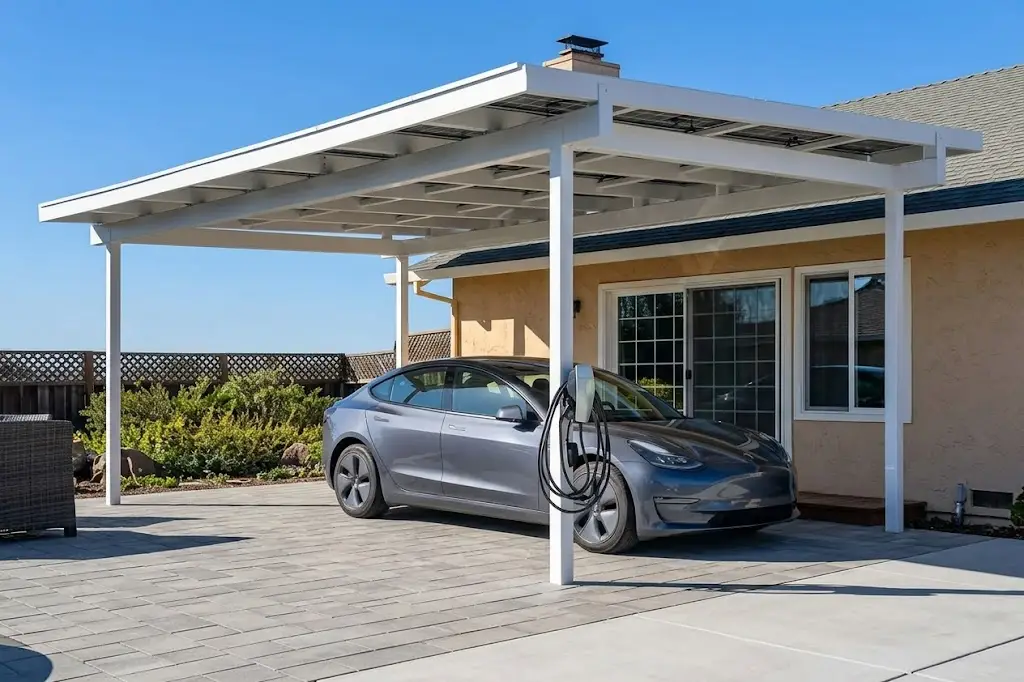
A Solar Patio Cover Can Become Part Of A Future-Ready Energy Plan
A solar patio cover creates a dedicated structure for solar panels while also improving the backyard. When EV charging is part of the discussion, the project can be planned around more than shade. It can consider the relationship between the patio, solar production, electrical routing, charger placement, and long-term energy needs. A solar patio cover may support EV charging readiness by helping homeowners plan:
- Solar panel layout
- Electrical equipment location
- Conduit routes
- EV charger location
- Battery backup options
- Electrical panel review
- Load management
- Future solar expansion
- Parking and driveway access
- Outdoor living design
- Permit and inspection coordination
The benefit is not only that the patio cover can hold solar panels. The real benefit is that the project can be designed with the next decade of home energy use in mind.
Explore Solar Patio Cover Cost Try the Solar Patio Cover Cost GuideSolar Production, EV Charging, And The Grid Must Be Understood Correctly
It is important to explain this clearly. A solar patio cover does not automatically mean your electric vehicle will charge directly from the panels at all times. Residential solar systems are usually tied into the home’s electrical system and utility connection. The EV charger uses power based on the home’s electrical setup, solar production, battery storage if installed, and grid conditions.
During sunny periods, solar production may help offset the electricity used by EV charging. If a battery is included, stored energy may also be part of the strategy depending on the system design. Actual performance depends on:
- Solar system size
- Sun exposure
- Panel orientation
- Time of day
- EV battery size
- Driving habits
- Charging speed
- Utility rates
- Home energy usage
- Battery storage, if included
- Electrical panel capacity
- System configuration
- Local utility and permitting requirements
This is why careful planning matters. The goal is not to make unrealistic claims. The goal is to design a better system.
Want Solar For Your EV But Not On Your Roof?
Many homeowners want solar because they own, or plan to buy, an electric vehicle. But that does not always mean they want panels on the main roof.
The roof may be older. The roof may be shaded. The roof may have limited usable space. The roofline may be visually important. The roof may need replacement in the future. The homeowner may simply prefer another location.
A solar patio cover gives EV owners another path. Instead of forcing the solar system onto the roof, the property can be reviewed for a dedicated solar patio structure that also creates a shaded outdoor living area.
This can make sense when:
- The homeowner wants solar but not on the roof
- The backyard has strong sun exposure
- The homeowner wants a patio cover anyway
- The EV charger location can be planned with the project
- Battery backup may be added now or later
- The main roof is not ideal for solar
- Outdoor living is part of the home improvement goal
Roof solar can still be a good option when the roof is ideal. But for EV owners who also want shade, design, and flexibility, a solar patio cover may be the more complete upgrade.
Compare solar patio covers vs roof solarWhat Does EV-Ready Mean For A Solar Patio Cover?
EV-ready does not always mean the charger is installed immediately. An EV-ready solar patio cover means the project is reviewed with future EV charging in mind. That may include planning for conduit, charger location, electrical panel capacity, load calculations, future wiring needs, battery options, and solar system sizing. This can be helpful for homeowners who do not own an electric vehicle yet but expect to buy one later. There are generally two project directions.
EV-Ready Planning
EV-ready planning may be right when the homeowner wants to prepare for a future electric vehicle without installing the charger immediately.
This may include reviewing:
- Potential charger location
- Electrical panel capacity
- Conduit planning
- Future wiring path
- Solar system sizing
- Battery compatibility
- Parking location
- Permit implications
- Future upgrade costs
EV Charger Installation Planning
EV charger installation planning may be right when the homeowner already owns an electric vehicle or expects to install a charger soon.
This may involve:
- Selecting charger type
- Reviewing charging speed needs
- Checking electrical capacity
- Planning wiring and equipment placement
- Coordinating with solar design
- Reviewing battery backup options
- Understanding permit and inspection requirements
Both paths benefit from early planning. The mistake is designing the solar patio cover first and thinking about EV charging later.
Most Homeowners Want To Understand Charging Speed
Home EV charging usually falls into two broad categories.
Level 1 Charging
Level 1 charging typically uses a standard household outlet. It may be slower, but it can be enough for some drivers with short daily commutes or limited charging needs.
Level 1 may not require the same level of electrical planning as a dedicated Level 2 charger, but the outlet, circuit, and safety requirements should still be reviewed.
Level 2 Charging
Level 2 charging is typically faster and often requires a dedicated circuit and charger installation. This is the option many EV owners consider when they want more practical overnight charging.
Level 2 charging can create a meaningful electrical load, so it should be reviewed with the home’s electrical panel, solar system, battery plans, and utility requirements. For solar patio cover planning, the charger level matters because it can affect:
- Electrical panel capacity
- Wiring needs
- Conduit routing
- Load calculations
- Permit requirements
- Battery planning
- Future expansion
- Solar system sizing
A solar patio cover project is a good time to have this conversation because electrical design is already part of the planning process.
Battery Backup Can Add Another Layer Of Flexibility
A solar patio cover with EV charging readiness can also be reviewed with battery backup. Battery backup may help store solar energy for later use, support selected circuits during an outage, and create a more resilient home energy plan. Whether the EV charger itself should be included in a backup strategy depends on the battery size, system configuration, load management, and homeowner priorities.
EV charging can use significant energy. Running an EV charger from battery backup may not be practical in every situation. In many cases, homeowners may choose to prioritize essential home loads during an outage rather than EV charging. That is why the project should define priorities early.
Possible goals may include:
- Use solar to help offset EV charging over time
- Make the home EV-ready for the future
- Install a Level 2 charger near the driveway or garage
- Add battery backup for essential loads
- Design a system that may allow future battery expansion
- Review whether the EV charger should be included in load management
- Understand what happens during normal operation versus an outage
A good solar patio cover plan should not treat EV charging and battery backup as afterthoughts. They should be part of the same energy conversation.
Attached Designs Can Work Well When The Patio, Home, And Charger Are Close Together
An attached solar patio cover connects to the home and creates a shaded outdoor living area near the main structure. This can work well when the EV charger, electrical panel, garage, driveway, or main living area are nearby.
Attached solar patio covers may be a good fit when:
- The patio is directly behind or beside the home
- The garage or driveway is close to the patio area
- Electrical routing can be planned efficiently
- The homeowner wants an indoor-outdoor living extension
- Solar panels should be kept off the main roof
- Battery backup may be reviewed with the home electrical system
- The design should feel integrated with the home
The attachment, structural design, solar layout, electrical routing, and local requirements should all be reviewed before finalizing the project. An attached solar patio cover should feel like part of the home, not like a separate piece of equipment added later.
Detached Designs Can Create A Separate Solar And Shade Structure
A detached solar patio cover is built away from the main home. This can be helpful when the best sun exposure is in the yard, near a pool area, near a driveway, or in another open part of the property. Detached designs may be useful for EV charging planning when the structure is close to a parking area or when the homeowner wants a separate solar shade zone.
Detached solar patio covers may be a good fit for:
- Poolside shade
- Outdoor kitchens
- Backyard lounges
- Open yard areas
- Large lots
- Driveway-adjacent structures
- Properties with limited roof solar potential
- Homes where the best solar exposure is away from the roof
When EV charging is involved, detached structures may require more electrical planning. Trenching, conduit, equipment placement, charger location, utility routing, and permit requirements may all affect the project. A detached solar patio cover can be a beautiful outdoor living feature, but it should be planned carefully if it is also expected to support solar and EV charging readiness.
Should You Build A Solar Patio Cover Or A Solar Carport?
Solar patio covers and solar carports can both support solar panels, but they serve different purposes. A solar patio cover is designed primarily for outdoor living. It creates shade for a patio, backyard, pool area, outdoor kitchen, or lounge space. A solar carport is designed primarily for vehicle parking. It creates shade for cars while supporting solar panels above. For EV charging, both options may be worth reviewing.
A solar carport may make sense when:
- The main goal is covered parking
- The EV charger should be close to the vehicle
- The driveway or parking area has strong sun exposure
- The homeowner wants solar over the car instead of the patio
A solar patio cover may make sense when:
- The homeowner wants outdoor living space
- The backyard has better solar exposure
- The home needs shade for dining, lounging, or entertaining
- The project should improve the backyard, not just the parking area
- The homeowner wants solar, shade, and lifestyle value together
The best answer depends on the property layout, parking location, sun exposure, electrical access, and how the homeowner wants to use the space.
What Affects The Cost Of A Solar Patio Cover For EV Charging?
A solar patio cover with EV charging readiness can vary in cost because it may include several different project scopes.
Cost factors may include:
- Patio cover size
- Attached or detached design
- Structure type and finish
- Footings and engineering requirements
- Solar system size
- Solar panel layout
- Electrical panel condition
- EV charger type
- Charger location
- Wiring and conduit needs
- Distance from panel to charger
- Battery backup options
- Load management needs
- Utility requirements
- Permit and inspection requirements
- Site access
- Trenching or exterior routing
- Future expansion planning
- Local city or county requirements
The project should be reviewed as a complete system. A basic patio cover price will not tell the full story. A roof-only solar quote will not tell the full story either. The better question is: What does it take to design shade, solar, electrical planning, and EV charging readiness together?
Try Our Solar Patio Cover Cost GuideCan EV Charging Be Included In Solar Patio Cover Financing?
EV charging readiness may be part of the financing conversation depending on the project scope, equipment, lender, installation requirements, and eligibility.
Because a solar patio cover with EV charging may include construction, solar, electrical work, and optional battery backup, financing should be reviewed carefully. Homeowners should ask:
- Is the patio cover included?
- Is the solar system included?
- Is EV charger installation included?
- Are electrical upgrades included?
- Is battery backup included?
- Are permit-related costs included?
- Are trenching or conduit costs included?
- What happens if EV charging is added later?
- Are there separate financing terms for different parts of the project?
Financing should be based on the full project scope, not just one piece of the upgrade.
EV Charging Can Add Electrical Requirements To The Project
A solar patio cover with EV charging readiness may involve more than patio cover construction. Depending on the project, review may include:
- Patio cover design
- Structural engineering
- Footings
- Solar system layout
- Electrical panel review
- EV charger circuit planning
- Battery backup coordination
- Utility requirements
- Load calculations
- Conduit and wiring routes
- Equipment placement
- Inspection requirements
Permit requirements vary by city, county, project type, structure, electrical scope, EV charger type, battery equipment, utility rules, and property conditions. This is why EV charging should be discussed early. A patio cover company may not understand solar and EV charging requirements. A solar company may not build patio structures. An EV charger installer may not coordinate outdoor living design. Solar Patios By Design™ helps bridge that gap by planning the project as a coordinated upgrade.
Southern California Homes Are Moving Toward Shade, Solar, And EV Readiness
Southern California homeowners often think about the same set of problems at the same time. The backyard is too hot. The roof may not be ideal for solar. The electric bill may be rising. An EV may already be in the driveway. Battery backup may be part of the future. The home needs to feel more comfortable and more prepared. A solar patio cover can bring these priorities together.
For homes in Ventura County, Los Angeles County, Orange County, Riverside County, and San Bernardino County, this combination can be especially practical because outdoor living and sun exposure are major parts of daily life. A well-planned solar patio cover can create:
- A cooler patio
- A more usable backyard
- A dedicated solar structure
- A cleaner way to plan EV charging
- A better foundation for battery backup
- A more intentional home energy upgrade
This is not just about adding panels. It is about designing the home around how people actually live now.
What Homeowners Should Avoid
A solar patio cover with EV charging readiness should not be rushed. The biggest problems usually happen when each part of the project is planned separately.
Common mistakes include:
- Building a patio cover without discussing future solar
- Installing solar without reviewing EV charging demand
- Adding an EV charger without checking electrical capacity
- Choosing a charger location before reviewing wiring routes
- Ignoring battery backup until after the system is designed
- Assuming every battery system can support EV charging during an outage
- Assuming the patio cover can support solar without structural review
- Assuming permits will be simple without checking local requirements
- Focusing only on equipment instead of the full home energy plan
The better approach is to start with the whole property.
- Where is the sun?
- Where is the patio?
- Where is the vehicle?
- Where is the electrical panel?
- Where might the battery go?
- What does the homeowner want the system to do?
A strong design starts with those questions.
Should Your EV Charger Be Backed Up By A Battery?
This depends on the homeowner’s priorities and system design. EV charging can use a lot of energy. In many backup situations, homeowners may prefer to reserve battery power for essential home loads like refrigeration, lighting, internet, garage access, medical equipment, or other priority circuits.
That does not mean EV charging cannot be part of the larger energy plan. It means the backup strategy should be realistic.
Questions to review include:
- Do you want the battery mainly for essential loads?
- Do you want to charge the EV from stored solar energy?
- Do you need the EV charger available during an outage?
- How much driving range do you need during backup conditions?
- How large would the battery system need to be?
- Would load management be required?
- Would EV charging reduce backup time for the home?
- Can solar recharge the battery during daylight?
- What does the utility or local authority require?
The right answer is different for every home.
For some homeowners, the goal is solar-assisted EV charging during normal conditions. For others, the goal is backup power for the home. For others, it is long-term preparation for more electric appliances, a future EV, or a second vehicle. A solar patio cover gives you the chance to plan those priorities before construction begins.
EV Charging Is Only One Part Of The Future Home Energy Picture
EV charging is often the first reason homeowners start thinking more seriously about electricity. But it may not be the last.
Future home energy needs may include:
- A second EV
- Battery backup
- Heat pump systems
- Electric appliances
- Pool equipment
- Outdoor kitchens
- Smart home systems
- Home office equipment
- Expanded solar capacity
- Additional outdoor living features
A solar patio cover can be part of that future planning. The purpose is not to overbuild the project. The purpose is to avoid designing a patio cover that ignores how the home may change.
A future-ready solar patio cover should consider:
- How the home uses power now
- How the home may use power later
- Whether the roof should be avoided
- Where solar exposure is strongest
- Whether battery backup may be added
- Where EV charging should be located
- Whether electrical upgrades may be needed
- How the finished patio should look and feel
The best projects feel simple when they are finished because the hard thinking happened early.
Solar Patio Covers For EV Charging Sit Between Multiple Trades
This kind of project sits in the middle of several industries.
- Patio cover construction.
- Solar design.
- Electrical planning.
- EV charging.
- Battery backup.
- Permits.
- Outdoor living design.
That is why homeowners can run into confusion. A patio cover contractor may only think about shade. A solar company may only think about panels. An EV charger installer may only think about the charger. A battery installer may only think about storage. But the homeowner needs one finished project that actually works together.
Solar Patios By Design™ is built around that gap. The goal is to help homeowners coordinate the patio structure, solar layout, electrical planning, EV readiness, battery options, permit planning, and finished outdoor living design as one project.
- One contractor.
- One design.
- Coordinated permitting.
- One finished project.
Planning Solar, Shade, And EV Charging?
Start with a solar patio cover review.
We can help you look at your backyard layout, roof condition, sun exposure, patio goals, EV charging needs, battery backup options, electrical planning, and permit considerations so you can understand what kind of project makes sense for your home.
Solar Patios By Design™ is operated by Team All Star Construction, CSLB #1009760.
Start With The Property, Not The Charger
A strong project begins with the full home.
Step 1: Review Your Patio Goals
Step 01
The design should start with how the outdoor space will be used. Do you want shade for dining, lounging, an outdoor kitchen, poolside seating, or a backyard entertainment area?
The patio cover needs to work as a real outdoor living structure, not just a solar rack.
Step 2: Review Solar Exposure
Step 02
The patio cover location should be reviewed for sun exposure, shade patterns, orientation, and usable panel space.
A beautiful patio cover in the wrong solar location may not support the energy goals well.
Step 3: Review EV Charging Needs
Step 03
The EV plan should consider charger location, charging speed, driving habits, daily mileage, parking location, and whether one or more EVs may need charging in the future.
Step 4: Review The Electrical System
Step 04
The home’s electrical panel, utility connection, wiring path, load capacity, and future expansion needs may all affect the project.
Step 5: Review Battery Backup Options
Step 05
Battery backup should be discussed early if the homeowner wants stored solar energy, essential-load backup, or future resilience.
Step 6: Review Permits And Local Requirements
Step 06
Permit requirements vary by city, county, structure, electrical scope, EV charger type, battery equipment, property conditions, and local authority.
Step 7: Build One Coordinated Plan
Step 07
The final project should connect shade, solar, EV readiness, battery options, electrical planning, and outdoor living into one finished design.
See Our Full ProcessSolar Patio Covers For EV Charging FAQs
Can a solar patio cover charge an electric vehicle?
A solar patio cover may support EV charging when the solar system and electrical design are properly planned. In most residential projects, solar panels connect to the home’s electrical system rather than directly to the vehicle. The EV charger then draws power based on the solar system, grid connection, battery storage if included, and overall electrical configuration.
Can I install an EV charger with a solar patio cover?
Yes. An EV charger may be included in the planning for a solar patio cover if the home’s electrical system, charger location, wiring path, panel capacity, permit requirements, and project scope allow. It is best to discuss EV charging early so the patio cover, solar system, and electrical plan can be coordinated.
Does a solar patio cover mean I can charge my EV for free?
Not necessarily. Solar production may help offset some EV charging usage, but actual savings depend on solar system size, sun exposure, driving habits, charging schedule, utility rates, home energy use, battery storage, and system design. No savings should be assumed without reviewing the specific project.
Should I add battery backup with EV charging?
Battery backup may be worth reviewing if you want stored solar energy, outage support, essential-load backup, or a more complete home energy plan. However, EV charging can use significant energy, so the battery system must be designed carefully. Some homeowners prioritize essential home loads over EV charging during outage conditions.
Can I make my solar patio cover EV-ready without installing a charger now?
Yes. Some projects can be planned with future EV charging in mind. EV-ready planning may include reviewing conduit routes, electrical capacity, charger location, solar system sizing, battery compatibility, and future wiring needs. This should be discussed before the patio cover design is finalized.
Do solar patio covers for EV charging need permits?
Permit requirements vary by city, county, project type, structure, electrical scope, EV charger type, battery equipment, utility requirements, property conditions, and local authority. A solar patio cover with EV charging may involve structural, solar, and electrical review.
Plan A Solar Patio Cover That Is Ready For What Comes Next
A solar patio cover can give your backyard shade today while helping prepare your home for tomorrow’s energy needs.
If you own an electric vehicle, plan to buy one, or simply want your home to be more future-ready, the best time to discuss EV charging is before the patio cover is designed.
Solar Patios By Design™ can help you review your backyard layout, solar exposure, roof condition, electrical system, battery backup options, charger location, and project requirements so your solar patio cover is planned as one coordinated upgrade.
Solar Patios By Design™ is operated by Team All Star Construction, CSLB #1009760.