
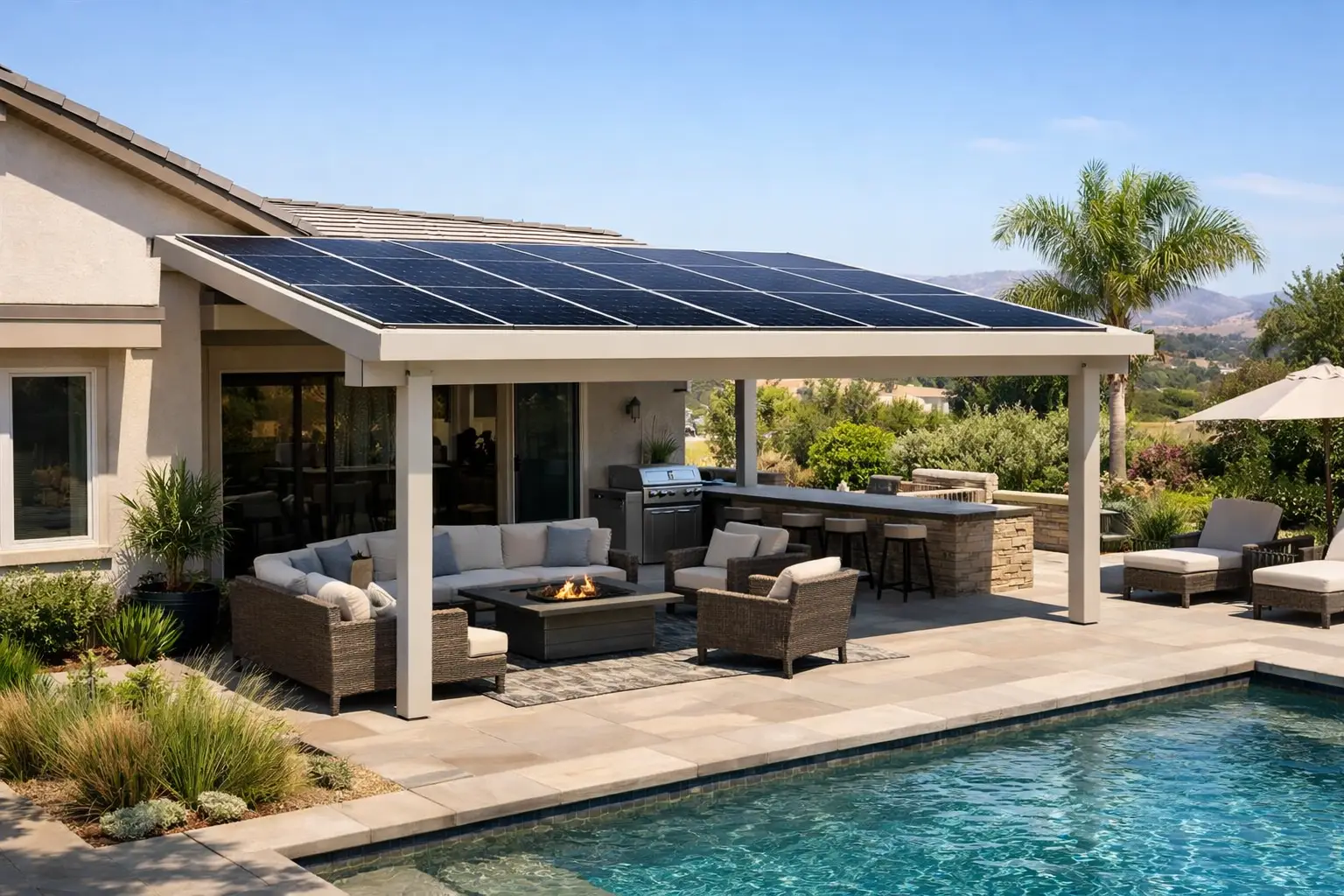
A backyard project usually forces a choice. Do you build a pergola for shade and comfort, or do you invest in solar to reduce reliance on utility power? Solar pergolas combine both goals into one structure, which is exactly why more Southern California homeowners are starting to look beyond rooftop panels.
For the right property, a solar pergola can create a usable outdoor living area while also generating electricity for the home. That combination matters in a region where sun exposure is strong, backyards are used year-round, and many homeowners want solar but do not want panels mounted on the roof. It is not the right fit for every lot or every budget, but when the design is done well, it can be one of the smartest ways to add function, comfort, and long-term value in a single project.
What are solar pergolas?
Solar pergolas are outdoor shade structures designed to support solar panels as part of the roof system or overhead cover. Unlike a traditional pergola that mainly adds visual interest and partial shade, a solar pergola is built with both structure and energy production in mind.
That difference is more significant than it sounds. A pergola built first and retrofitted later often runs into limitations with span, orientation, attachment points, engineering, and panel layout. A true solar pergola needs the structure, solar design, and electrical planning to work together from the beginning.
For homeowners, the appeal is straightforward. You are not just adding a patio feature. You are creating shade, improving outdoor living, and adding a solar-ready surface that may help offset a portion of household electricity use.
Why homeowners are choosing solar pergolas
The biggest reason is simple: many people want solar, but not on their roof. Some roofs have limited space. Others have poor orientation, multiple facets, vents, or design concerns that make rooftop panels less appealing. In some cases, the homeowner simply prefers to keep the roofline clean.
A solar pergola offers another path. It can be placed where sun exposure is favorable, where backyard use already happens, and where the structure adds daily value beyond energy production. That makes it different from a standard solar installation. The project is not only about kilowatt-hours. It is also about comfort and design.
In Southern California, that matters. In inland areas such as Riverside County and San Bernardino County, summer heat makes covered outdoor space much more usable. In coastal and higher-end neighborhoods across Orange County and Los Angeles County, appearance often carries equal weight with performance. Homeowners are not just asking how much power a system can produce. They are asking how it will look, how it will feel, and whether it fits the home.
The main benefits of solar pergolas
A well-designed solar pergola can solve more than one problem at once. First, it creates shade where you actually need it – over a patio, outdoor kitchen, lounge area, or backyard gathering space. Second, it provides a dedicated location for solar panels without relying on the house roof. Third, it can make a backyard feel more intentional and complete.
There is also a convenience factor that homeowners often overlook at first. Combining a patio cover project and a solar project into one plan can be more efficient than treating them as separate upgrades months or years apart. Design, engineering, permits, and construction can be coordinated around one finished result instead of trying to fit one improvement around another later.
For some households, solar pergolas also support future-ready planning. If you are thinking about battery backup readiness or EV charging readiness, a solar structure may become part of a larger energy strategy. That does not mean every pergola should be oversized for future use, but it does mean the project can be designed with those goals in mind.
Where solar pergolas work best
Not every backyard is ideal. The best locations typically have strong sun exposure, enough open space for the structure, and a layout where shade adds obvious lifestyle value. A patio adjacent to the house can be a strong candidate, but detached backyard placements can work well too.
Orientation matters, although there is no one-size-fits-all answer. South-facing and west-facing exposure can be helpful in many cases, but site conditions, home layout, utility goals, and shade from nearby trees or structures all affect the design. A pergola placed for perfect outdoor comfort is not always placed for the highest energy production, so there is often a balance to strike.
That trade-off is worth understanding early. If your top priority is maximum solar output, the structure may need to be designed differently than if your top priority is afternoon shade over an entertainment area. The best projects respect both goals instead of pretending there is never a compromise.
Design choices that matter
The success of a solar pergola is not only about the panels. It depends on proportion, materials, structural engineering, roof style, column placement, and how the structure relates to the home.
Some homeowners prefer a more open pergola look. Others want a more solid patio cover feel with stronger weather protection and a cleaner panel field. The right choice depends on how the space will be used and how much shade coverage is needed. A decorative pergola with limited overhead surface is very different from a structure designed to carry a meaningful solar array.
Material selection matters too. In Southern California, many homeowners want low-maintenance finishes that hold up well in sun and heat. The structure should feel like a natural extension of the property, not an afterthought built only to hold panels.
This is where integrated design makes a real difference. A company that understands both patio cover construction and solar planning can address the structure as one complete system rather than two separate scopes trying to share the same footprint.
What do solar pergolas cost?
Cost depends on structure size, span, materials, engineering requirements, panel count, electrical scope, finish level, and site conditions. Attached and detached designs can have different structural and permit considerations. A simple backyard installation on a clear lot will not price the same as a custom structure with lighting, an outdoor kitchen connection, upgraded finishes, and expanded electrical planning.
Homeowners should also keep the comparison fair. A solar pergola is not just a solar system, and it is not just a pergola. It is both. Looking only at the cost per watt misses the shade and outdoor living value. Looking only at the patio cover cost misses the power-generating side of the project.
That is why the most useful budgeting approach is to evaluate it as a combined home improvement. You are investing in a covered outdoor space that may also produce electricity and support broader energy goals. The patio cover that pays you back is a useful way to think about it, as long as expectations stay realistic and project-specific.
Solar pergolas vs rooftop solar
Rooftop solar still makes sense for many homes. It can be more direct when the roof has good orientation, enough usable space, and no major design objections. But rooftop solar is not automatically the best answer for every property.
Solar pergolas are especially appealing when the roof is shaded, fragmented, aging, visually sensitive, or simply not where the homeowner wants panels. They also make sense when a homeowner already needs a patio cover and wants to combine two projects into one investment.
The trade-off is that a solar pergola requires structural construction in addition to solar equipment. That means design complexity can be higher. On the other hand, it may give the homeowner a more attractive and more functional result than roof-mounted panels alone.
Local factors in Southern California
Southern California homes are well suited to outdoor living, but local conditions still shape the project. Inland heat can increase the value of covered space. Coastal properties may bring different style priorities and exposure conditions. HOA review can affect appearance, placement, and visible structural details. Permit requirements vary by city, structure type, and electrical scope.
That is why local experience matters. A solar pergola is not a generic shade structure, and it is not a standard rooftop install moved into the backyard. The design has to respond to the home, the lot, and the jurisdiction.
For homeowners weighing options, the best early step is to think through three questions. Where do you actually want shade? How important is avoiding rooftop solar? And do you want this project to improve daily backyard use, not just energy production?
When those answers point in the same direction, solar pergolas become much more than a niche idea. They become a practical way to add comfort, design, and power where your family will notice it most.
Solar Patios By Design™ focuses on that exact intersection – outdoor living structures and solar working together as one plan. For homeowners who want shade, usable space, and a smart alternative to rooftop panels, that combination is often where the best project starts.