
What Southern California Homeowners Should Actually Budget For
A solar patio cover costs more than a plain patio cover. It also costs more than a typical roof-mounted solar install. Why? Because it’s pulling double duty — it has to function as a genuine outdoor structure and hold up as a solar support system at the same time.
That dual job is what drives the price. You’re not just paying for a patio cover’s size or a solar array’s wattage — you’re paying for how the two come together: structure, solar layout, electrical work, engineering, footings, permits, finishes, possibly a battery, possibly EV charging.
For most Southern California homeowners, a realistic planning budget lands somewhere between $25,000 and $90,000+, before factoring in financing, rebates, or incentives. Smaller setups can dip below that. Bigger custom builds — especially detached structures or anything with battery backup — can climb well past it.
So instead of asking “how much does a patio cover cost?”, the more useful question is:
How much shade, solar capacity, structure, and electrical planning does your home actually need?
Solar Patios By Design™ is operated by Team All Star Construction, CSLB #1009760.
Direct AnswerThe Short Answer
A solar patio cover in Southern California typically runs $25,000 to $90,000+, depending on size, structure, panel layout, engineering, footings, electrical scope, permits, finishes, battery backup, and EV readiness. A smaller 10×20 setup tends to land around $22,000–$45,000, while a larger 14×28 build can run $45,000–$85,000+. These are planning ranges, not quotes — your actual number depends on your specific design.
Get My Solar Patio Cover EstimateSolar Patio Cover Cost at a Glance
Two things really drive the price here: the patio structure itself, and the solar system sitting on top of it.
A standard Alumawood patio cover can usually be priced out by square footage alone. Add solar panels, though, and that simple math breaks down — now you’re also accounting for panel weight, wind load, engineering, footings, electrical routing, inverter placement, possible battery storage, and permitting.
Quick Planning Table
Swipe sideways to see every column.
| Solar Patio Cover Size | Approx. Patio Area | Possible Solar Capacity | Planning Cost Range |
|---|---|---|---|
| Small 10×20 | 200 sq. ft. | ~3.2–4.6 kW | $22,000–$45,000 |
| Medium 12×24 | 288 sq. ft. | ~4.8–6.4 kW | $30,000–$60,000 |
| Large 14×28 | 392 sq. ft. | ~6.4–9.2 kW | $45,000–$85,000+ |
| Oversized 16×32 | 512 sq. ft. | ~8.0–11.0 kW | $60,000–$110,000+ |
Again — these are planning ranges, built from comparable solar structure and patio cover costs. Your project could land lower or higher.
Why Solar Patio Covers Cost More Than Regular Ones
A regular patio cover just needs to provide shade. That’s it. A solar patio cover has a longer list of jobs: shade, solar support, electrical integration, and long-term energy planning, all at once.
That changes the engineering. A basic patio cover only has to hold up its own roof. A solar version needs to handle panel weight, wind uplift, racking, conduit, electrical equipment, and room for future servicing. The design also has to account for sun exposure, roof pitch, drainage, and what inspectors will be looking for.
That’s really the core point: a solar patio cover shouldn’t be treated like a regular cover with panels bolted on as an afterthought. It needs to be designed as one system, from day one.
One contractor. One design. Coordinated permitting. One finished project.
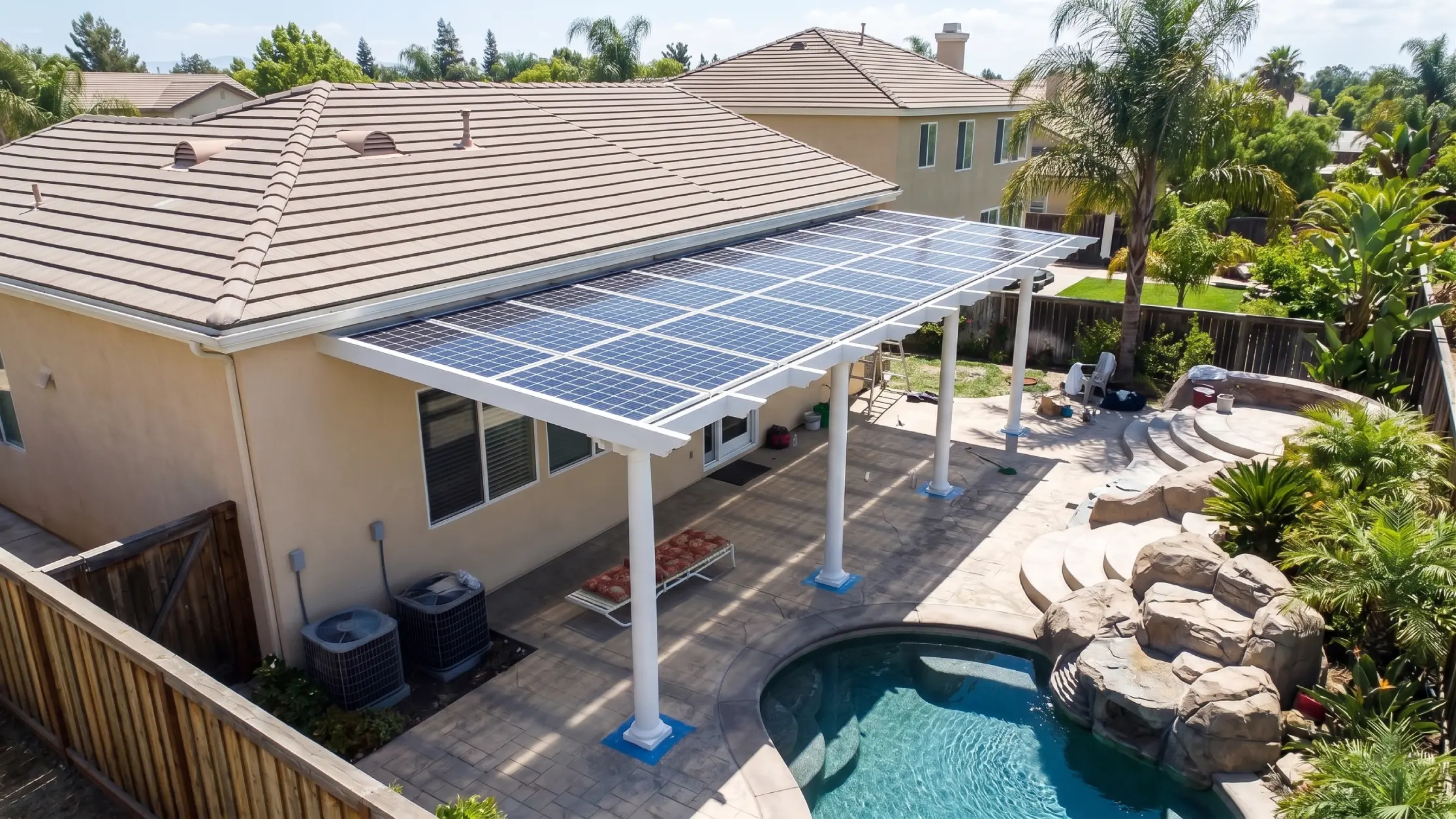
Cost by Size
10x20 Solar Patio Cover — $22,000 to $45,000
About 200 square feet of covered space, supporting roughly 8–10 panels (3.2–4.6 kW), depending on layout and spacing.
Good fit for:
- Backyard dining areas
- Small attached patios
- Poolside seating
- Shade near sliding doors
- Compact outdoor living spaces
The lower end fits simpler builds with easy site conditions. The higher end shows up when you need upgraded engineering, deeper footings, more complex electrical routing, nicer finishes, or battery/EV readiness baked in.
12x24 Solar Patio Cover — $30,000 to $60,000
About 288 square feet, supporting roughly 12–14 panels (4.8–6.4 kW). This is one of the more practical sizes for SoCal homes — big enough to feel like a real outdoor room, while still supporting a meaningful solar setup.
Good fit for:
- Outdoor dining spaces
- Larger backyard patios
- Attached Alumawood solar covers
- Outdoor kitchens
- Family seating areas
- Solar-ready shade structures
14x28 Solar Patio Cover — $45,000 to $85,000+
About 392 square feet, supporting roughly 16–20 panels (6.4–9.2 kW). At this size, you’re moving past “patio cover” territory and into something closer to a true solar patio roof.
Good fit for:
- Large backyard patios
- Poolside shade
- Outdoor kitchens
- Detached solar covers
- Homes with higher electricity usage
- Battery-ready planning
- EV charging readiness
Larger Custom Builds — $60,000 to $110,000+
This range covers bigger detached structures, more complex attached solar roofs, heavy-duty engineering, larger arrays, battery infrastructure, EV charger planning, outdoor kitchen coverage, and custom architectural finishes.
At this scale, think of it less as “a patio cover” and more as a full energy-plus-outdoor-living project.
Cost Per Watt
Solar projects are usually priced per watt. For a basic roof-mounted system, that number tends to be lower — the roof’s already there, after all. A solar patio cover is a different animal, because you’re building the structure from scratch.
In a lot of ways, it prices out more like a solar carport than a rooftop system, since it includes posts, beams, footings, engineering, panels, racking, conduit, wiring, inverters, permits, inspections, and electrical coordination — all wrapped into one project.
A reasonable planning range: $4.00 to $7.50+ per watt, depending on structure, finish level, electrical scope, and whether it’s attached, detached, battery-ready, or EV-ready.
Swipe sideways to see every column.
| Solar Capacity | Lower Range | Higher Range |
|---|---|---|
| 4 kW | $16,000 | $30,000+ |
| 6 kW | $24,000 | $45,000+ |
| 8 kW | $32,000 | $60,000+ |
| 10 kW | $40,000 | $75,000+ |
Useful for understanding the solar side of things — but it won’t always capture every outdoor-living upgrade, finish choice, footing challenge, or electrical wrinkle.
Cost Per Square Foot
You can talk about a patio cover in terms of price per square foot — that’s standard for non-solar builds. With a solar patio cover, though, that number gets shakier, because the solar system’s size matters just as much as the patio’s footprint.
A non-solar cover is usually much cheaper per square foot. A solar version costs more because it’s carrying structural solar planning, electrical work, engineering, and equipment on top of the basic build.
A reasonable range: $110 to $220+ per square foot. That sounds steep next to a regular patio cover, but remember — you’re not just buying shade. You’re buying panels, structure, engineering, electrical integration, and permit coordination, all in one package.
Swipe sideways to see every column.
| Size | Approx. Area | Estimated Project Range |
|---|---|---|
| 10×20 | 200 sq. ft. | $22,000–$45,000 |
| 12×24 | 288 sq. ft. | $30,000–$60,000 |
| 14×28 | 392 sq. ft. | $45,000–$85,000+ |
| 16×32 | 512 sq. ft. | $60,000–$110,000+ |
How It Compares to Other Options
Swipe sideways to see every column.
| Option | Typical Pricing Logic | What You're Getting |
|---|---|---|
| Regular Patio Cover | Priced by square foot | Shade and outdoor comfort |
| Roof-Mounted Solar | Priced by watt | Energy production on your existing roof |
| Solar Patio Cover | Priced by structure + wattage | Shade, outdoor living, and solar in one |
| Solar Carport | Similar logic to patio cover | Vehicle shade plus energy production |
Here’s the honest truth: a solar patio cover is rarely the cheapest way to go solar. Roof solar usually wins on price, simply because the roof already exists — you’re not building anything new underneath the panels.
But a solar patio cover solves a different problem. It makes sense when you want shade, more usable outdoor space, and solar production, all from one project. It’s also worth a look when your main roof isn’t a great solar candidate — maybe it’s older, oddly shaped, partially shaded, tiled in a way that complicates installation, or just doesn’t have the space.
Attached vs. Detached
Attached Solar Patio Covers
These connect directly to the house, which can feel like a natural extension of your indoor living space — but the connection point itself adds complexity. Cost depends on:
- Exterior wall or fascia condition
- Roofline and eave details
- Existing framing
- Post placement
- Drainage
- Footings
- Electrical routing
- Panel layout
- Permit requirements
Smaller attached builds may start in the low-to-mid $20,000s as a planning figure; larger ones can run $50,000–$90,000+.
Best for: main backyard patios, sliding glass doors, outdoor dining, kitchens close to the house, shade right outside your back door.
Detached Solar Patio Covers
These stand on their own, which opens up design flexibility — but also means the structure has to support itself without leaning on the house at all. Cost factors include:
- Freestanding structure design
- Post count
- Footing depth
- Setback requirements
- Distance from the home
- Trenching
- Electrical routing
- Panel layout
- Permits
- Outdoor kitchen or pool planning
Detached builds can run pricier than attached ones, especially if they need trenching or longer conduit runs.
Best for: poolside shade, backyard lounges, outdoor kitchens away from the house, deep-yard seating, or solar placement that sidesteps roof limitations entirely.
What About Alumawood?
Alumawood is popular for a reason — it gives you the look of painted wood with a lot less maintenance. For a standard patio cover, it’s a solid, attractive choice.
For solar, though, engineering is what really matters. A standard Alumawood cover isn’t automatically solar-ready. If panels are going on now (or even just might go on later), the structure needs review for beam size, post size, footings, attachment details, panel weight, wind uplift, racking layout, electrical routing, and permitting.
Bottom line: an Alumawood solar patio cover usually costs more than a standard one, because it has to be engineered around solar loads from the start — not retrofitted later.
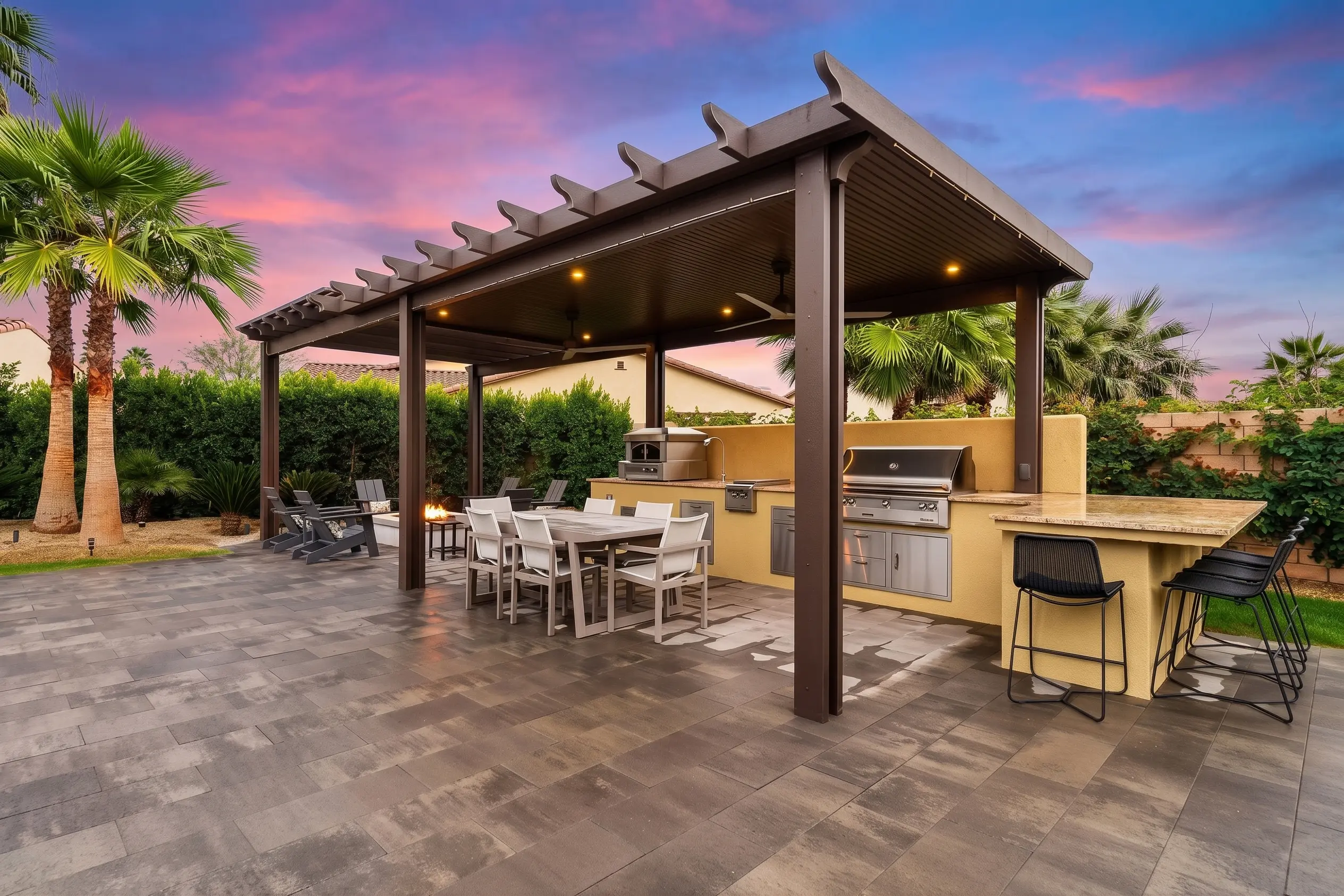
What Drives the Price Up
- Size — bigger means more material, more panels, more structure, more labor.
- Solar capacity — a 4 kW system and a 10 kW system are genuinely different projects, with different racking, wiring, inverter, and panel-upgrade needs.
- Attached vs. detached — attached needs careful integration with the house; detached needs its own footings and often longer electrical runs.
- Engineering — panels add weight and wind-load considerations, making this one of the most important pieces of the whole project.
- Footings — depth and design shift based on soil, post location, structure height, and local code.
- Electrical work — conduit, wiring, inverter placement, panel review, possible main panel upgrades, battery prep, EV prep — this can move the budget fast.
- Battery backup — can add significantly to cost, depending on battery size, which loads you want backed up, equipment placement, and utility requirements.
- EV charging readiness — may need conduit, wiring, a dedicated charger location, or even a panel upgrade.
- Permits — vary a lot by city, county, structure size, electrical scope, and property specifics.
- Finish options — lighting, fans, outdoor kitchen coverage, upgraded columns, custom colors, drainage, gutters — all of it adds up.
Tax Credits — Don't Assume Anything
In past years, some residential solar and battery storage costs may have qualified for federal clean energy credits, provided the project met IRS rules and was placed in service during an eligible window. But incentive rules shift, and components that mainly serve a structural or roofing function may not qualify the same way solar equipment does.
The honest advice here: talk to a qualified tax professional, your solar provider, and check current IRS guidance before assuming any credit, rebate, or incentive applies to your project. This matters even more for solar patio covers specifically, since they combine a structural shade component with a solar energy component — and those two pieces may not be treated the same way under current rules.
Can Financing Help?
Financing can spread the cost out instead of requiring full payment upfront. What makes sense for you depends on total project cost, credit approval, loan terms, interest rate, monthly payment, equipment costs, battery and EV add-ons, and whether you’re building everything at once or phasing it in.
One thing worth keeping in mind: a lower monthly payment isn’t the same thing as a lower total cost. Read the terms carefully.
Is It Actually Worth It?
A solar patio cover might be worth it if you’re after more than just shade. It’s a good fit if you want:
- A backyard that actually gets used
- Shade over your outdoor living space
- Solar without touching your main roof
- A structure built with long-term energy use in mind
- Battery backup options
- EV charging readiness
- Something that feels like a real extension of the house
- One coordinated build instead of two separate projects
It’s probably not your cheapest path to solar — roof-mounted panels usually win there, assuming your roof is in good shape, well-oriented, and has the space. But a solar patio cover solves a different problem: it gives you shade, better outdoor living, and solar production, all in one move.
Getting a Real Estimate
A proper estimate goes beyond a quick square-foot number. It should take into account:
- Your home address
- Photos of the patio area
- Attached vs. detached preference
- Approximate size
- Sun exposure
- Roofline and yard layout
- Electrical panel location
- Battery backup goals
- EV charging plans
- Outdoor kitchen plans
- HOA requirements
- Local permit requirements
- Desired finish level
- Budget range
Southern California Pricing Varies by Region
Pricing shifts depending on where you are. A coastal home in Ventura County deals with different wind, corrosion, and HOA factors than an inland Riverside County property. A Los Angeles County home might face different access, electrical, and permitting hurdles than a newer Orange County build. San Bernardino County often means bigger lots, stronger sun exposure, and more room for detached structures.
Solar Patios By Design™ serves homeowners across Ventura, Los Angeles, Orange, Riverside, and San Bernardino counties.
Solar Patio Cover Cost FAQs
How much does a solar patio cover cost?
Generally $25,000 to $90,000+ in Southern California, depending on size, structure, solar layout, engineering, footings, electrical work, permits, finishes, battery backup, EV readiness, and site conditions.
How much does a 10x20 solar patio cover cost?
Around $22,000 to $45,000, depending on structure, panel count, attachment method, footings, electrical routing, permits, and finishes.
How much does a 12x24 solar patio cover cost?
Around $30,000 to $60,000 — a size that often supports a solid solar layout while still giving you real usable outdoor living space.
How much does a 14x28 solar patio cover cost?
Around $45,000 to $85,000+, depending on solar capacity, engineering, attached vs. detached design, electrical scope, permits, and any outdoor living upgrades.
Is a solar patio cover more expensive than roof solar?
Usually, yes — roof solar skips the cost of building a new structure entirely.
Is a solar patio cover more expensive than a regular patio cover?
Yes. A regular cover just needs to provide shade. A solar version also has to support panels, racking, electrical equipment, wind loads, and pass inspection.
Is a solar patio cover more expensive than a regular patio cover?
Yes. A regular cover just needs to provide shade. A solar version also has to support panels, racking, electrical equipment, wind loads, and pass inspection.
What affects the cost the most?
Size, solar system capacity, attached vs. detached design, engineering, footings, electrical work, panel layout, permits, battery backup, EV readiness, and finish choices.
Can I add solar panels to a patio cover later?
Sometimes — but only if the structure was built or upgraded to handle solar loads. Most standard covers aren’t automatically solar-ready, so if there’s any chance you’ll add panels down the line, it’s worth planning for that from the start.
Does battery backup increase the cost?
Yes, and the amount depends on battery size, which loads you want backed up, equipment placement, utility requirements, and permitting.
Does EV charging readiness increase the cost?
It can — especially if it requires conduit, wiring, a dedicated charger spot, or a panel upgrade.
Do solar patio covers need permits?
Usually, yes. Requirements vary by city, county, structure type and size, attachment method, electrical scope, HOA rules, and local authority.