
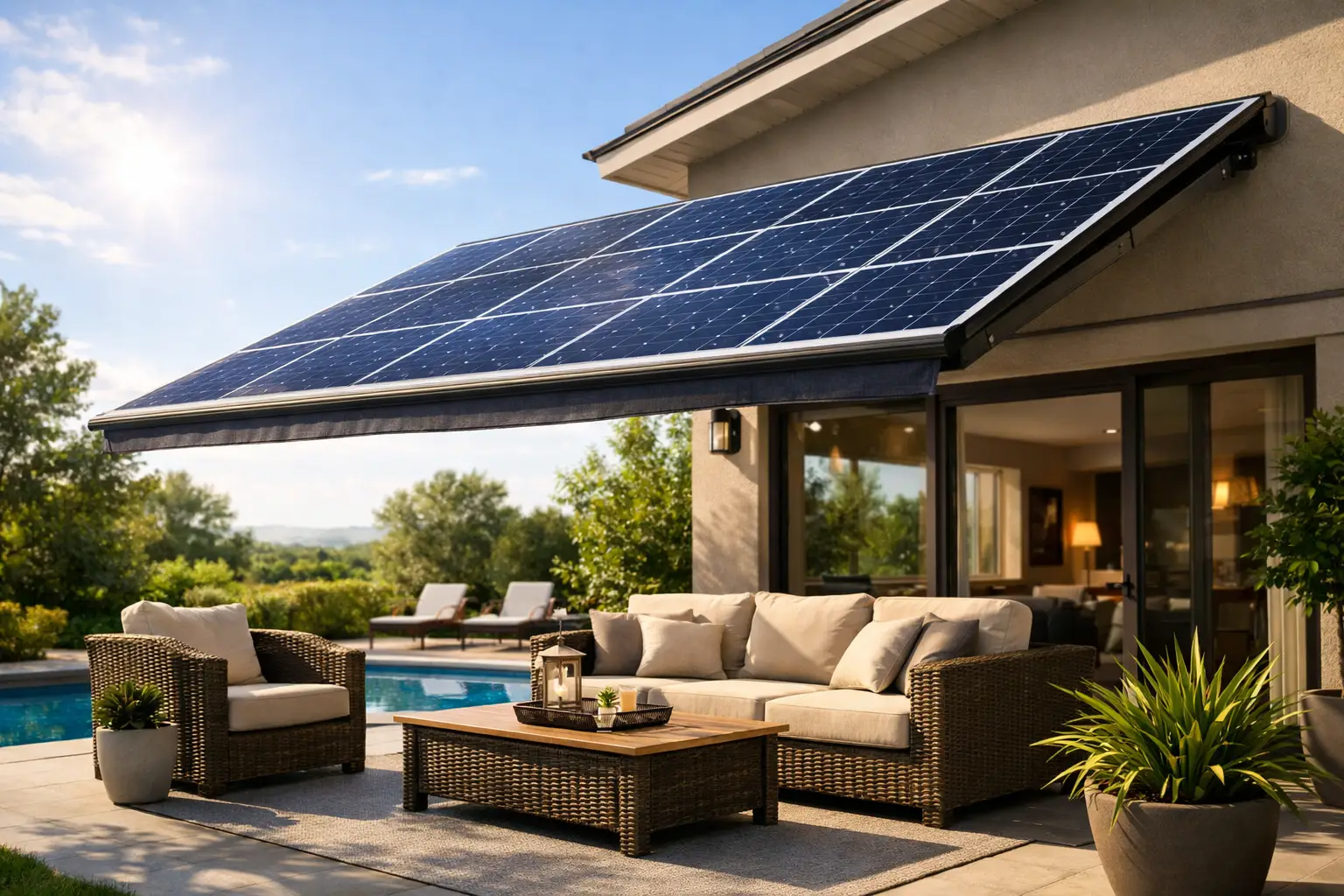
A backyard project usually asks you to choose one priority. You can add shade. Or improve outdoor living. Or invest in solar. A solar patio awning is one of the few upgrades that can bring all three together, which is why more Southern California homeowners are looking at it as an alternative to rooftop panels.
For the right home, a solar patio awning does more than cover a patio. It creates a usable outdoor space while producing electricity from an area that would otherwise just block the sun. That said, the best result depends on design, orientation, structural planning, and whether an awning-style system is truly the best fit compared with a full patio cover, pergola, or another solar shade structure.
What a solar patio awning actually is
A solar patio awning is an overhead shade structure that incorporates solar panels into the roof or canopy area. In some cases, homeowners use the term loosely to describe any patio cover with solar panels. In others, they mean a more traditional awning profile attached to the home and extending over a patio or outdoor seating area.
That distinction matters. A lightweight retractable awning and a permanent solar-ready patio structure are not the same thing. Solar panels require a stable, engineered support system that can handle panel weight, wind loads, attachment requirements, and local permitting. In practice, many homeowners who start by searching for a solar patio awning are really better served by a fixed solar patio cover designed from the ground up for both shade and power generation.
Why homeowners consider a solar patio awning
In Southern California, patios are not just decorative space. They are part of daily living. Families eat outside, entertain year-round, add outdoor kitchens, and look for ways to make the backyard more comfortable without increasing utility costs.
That is where this type of project stands out. Instead of treating shade and solar as separate upgrades, a solar patio awning combines them into one investment. You gain relief from direct sun, reduce heat over doors and windows near the patio, and create a place for panels without using roof space.
For homeowners who want solar but do not want panels mounted on the roof, this can be especially appealing. Some homes have limited roof space. Others have roofing materials, angles, or layouts that are not ideal for solar production. Some homeowners simply prefer the cleaner look of keeping panels off the main roofline.
The biggest benefits of a solar patio awning
The first benefit is comfort. A covered patio changes how often you actually use your yard. Midday sun becomes less intense, furniture lasts longer, and the area feels more like an outdoor room than an exposed slab of concrete.
The second benefit is energy production. When designed correctly, the structure is not just providing shade. It is generating electricity that can support household usage, offset utility bills, and work as part of a broader energy plan that may eventually include battery backup or EV charging.
The third benefit is efficiency in project planning. Homeowners often discover that building a patio cover first and adding solar later can create avoidable complications. The structure may not be engineered for panels. Electrical planning may be limited. The final look can feel pieced together instead of intentional. A unified design process usually produces a better result visually and functionally.
There is also a home value angle. Buyers in Southern California tend to notice outdoor living upgrades, especially ones that feel permanent, attractive, and energy-conscious. Not every improvement pays back equally, but a well-designed solar shade structure can support both lifestyle value and market appeal.
Where the trade-offs show up
A solar patio awning is not automatically the best answer for every property. One of the most common issues is orientation. Shade structures do not always face the ideal direction for maximum solar production. If the patio sits on a part of the home with poor sun exposure, nearby trees, or consistent shading from neighboring structures, the power output may be lower than expected.
Design is another trade-off. Some homeowners want an airy awning or lattice look, but solar panels require enough solid surface area and structural integrity to work effectively. You may need to choose between a lighter visual style and a more practical solar layout.
There is also the question of scale. If your main goal is to offset a large share of your electric bill, a small awning may not provide enough panel area. In that case, a larger solar patio cover, pergola, or carport may make more sense. If your goal is modest energy support paired with backyard comfort, then the smaller awning concept can be a strong fit.
Solar patio awning vs rooftop solar
This is often the real comparison homeowners are trying to make.
Rooftop solar usually offers the advantage of using an existing structure, which can reduce the need for new construction if the roof is suitable. But that phrase matters – if the roof is suitable. Not every roof is. Age, slope, orientation, penetrations, limited space, and aesthetics all affect whether rooftop solar is truly the best option.
A solar patio awning offers a different path. It gives homeowners usable shade and outdoor living space while creating a dedicated area for solar panels. It can also preserve the appearance of the main roofline and avoid some of the concerns homeowners have about rooftop equipment.
The trade-off is that a solar awning involves structural construction, not just panel installation. That usually means more design decisions, more site-specific engineering, and a bigger conversation about how the new structure will function in daily life. For many homeowners, that is a benefit rather than a drawback because the project solves multiple needs at once.
Cost depends on more than the panels
Homeowners often ask for a simple price, but solar patio awning costs vary because the project is part construction and part solar installation. The final number depends on size, materials, attachment method, engineering, electrical scope, panel layout, finish level, and local permit requirements.
If the structure is attached to the home, installation details can be different from a freestanding design. If the patio includes lighting, ceiling fans, an outdoor kitchen, or future battery and EV charging plans, the electrical design becomes more involved. If the goal is a premium architectural finish rather than a basic utility structure, cost moves accordingly.
That is why one-contractor planning matters. When the patio structure and solar system are treated as one integrated project, the homeowner gets clearer expectations about design, permitting, and performance.
Southern California considerations
In Los Angeles, Orange County, Riverside, San Bernardino, Ventura, and San Diego County, outdoor living is a major part of home design. So is sun exposure. That makes the concept appealing, but local realities still matter.
Permitting can vary by city. HOA review can affect appearance, placement, and attachment details. Wind exposure, lot layout, and property line setbacks may influence what kind of awning or patio cover is possible. Coastal areas may raise different material considerations than inland communities where heat is a bigger concern.
This is also a region where homeowners often think ahead. A solar patio awning may start as a shade project, but it can become part of a longer-term plan that includes lower utility bills, backup power readiness, and charging an electric vehicle at home. Designing with those future uses in mind is usually smarter than retrofitting later.
When a solar patio awning makes the most sense
A solar patio awning is usually a strong option when you already need backyard shade, want to improve how you use your outdoor space, and prefer a solar alternative to rooftop panels. It also makes sense when your roof has limitations or when you want one project that combines aesthetics, comfort, and energy production.
It may be less ideal if your patio area gets limited sun, the available footprint is too small for meaningful panel capacity, or your main priority is simply installing the lowest-cost solar system possible. In those cases, another solar layout or a larger patio cover structure may be the better answer.
For many homeowners, the smartest first step is not asking, “What does a solar patio awning cost?” It is asking, “What kind of solar shade structure fits my home, my yard, and the way I actually live outside?” That question usually leads to a better design and a better long-term investment.
Solar Patios By Design™ focuses on exactly that intersection – shade, outdoor living, and solar power in one project. And for homeowners who want solar but not on the roof, that combination is often where the real opportunity begins.
The best backyard upgrades are the ones you enjoy every day while they quietly keep working in the background. A well-planned solar patio awning can do both.