
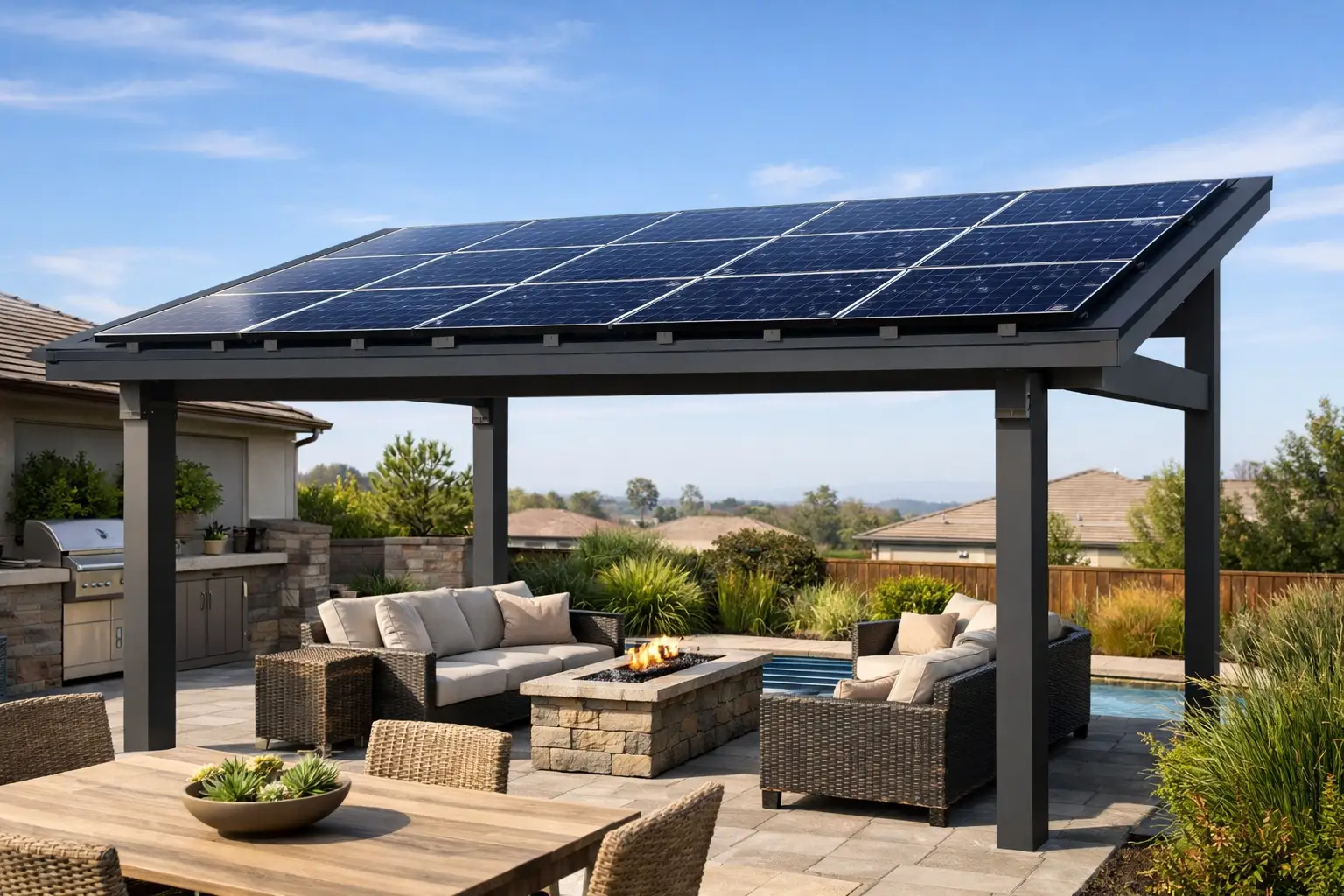
If your roof gets too much shade, faces the wrong direction, or you simply do not want panels mounted on your home, you may be asking: can you put solar panels on a patio cover? In many cases, yes. A properly designed patio cover can support solar panels and give you something a standard roof-mounted system cannot – shade, outdoor living space, and power generation in one project.
That said, this is not as simple as attaching panels to any backyard structure. Whether it works depends on the patio cover design, the engineering, your local permitting requirements, and how much energy you expect the system to produce.
Can you put solar panels on a patio cover? Yes, but it depends on the structure
A patio cover can absolutely be built or upgraded to hold solar panels. In fact, for many Southern California homeowners, it is one of the smartest alternatives to rooftop solar. It creates a dedicated solar structure while also improving the way the backyard functions.
The key is that the patio cover must be designed for solar from the beginning, or carefully evaluated before panels are added later. Solar panels add weight. They also create wind load, attachment requirements, wiring pathways, and structural considerations that ordinary patio covers are often not built to handle.
This is where many homeowners run into confusion. A traditional patio cover contractor may know how to build shade structures, but not how to prepare one for solar. A conventional solar installer may know the electrical side, but not how to engineer and build the patio cover itself. When those two scopes are treated separately, details get missed.
Why a solar patio cover makes sense
For the right home, a solar patio cover solves several problems at once. It provides usable shade over a seating area, outdoor kitchen, or backyard entertaining space. It can reduce heat in the area below. And it gives homeowners a place to install solar without using the roof.
That matters more than many people realize. Some homes have tile roofs that owners do not want penetrated. Others have limited roof space, poor roof orientation, too much shade from nearby trees, or aesthetic concerns about rooftop panels facing the street. A patio cover offers another path.
There is also a design advantage. A solar patio cover can look intentional and integrated rather than added as an afterthought. Done well, it becomes part of the architecture of the backyard while supporting long-term energy goals.
Not every patio cover is solar-ready
This is the most important trade-off to understand. Yes, you can put solar panels on a patio cover, but not every patio cover should have them.
A lightweight lattice cover, for example, usually is not suitable for standard solar panels without major structural changes. Many older wood or aluminum patio covers were built only for shade, not for the additional dead load and uplift forces that come with solar. Even if a contractor says panels can physically fit, that does not mean the structure is appropriate.
Insulated roof patio covers, solid covers, and engineered pergola-style systems are often better candidates, especially when they are designed around the solar layout from day one. The panel dimensions, beam spacing, post locations, spans, and footings all matter.
If you are planning a new backyard structure, building it as a solar patio cover from the start is usually more efficient than trying to retrofit a cover later. You avoid compromise on design, and the engineering can account for solar loads from the beginning.
What makes a patio cover good for solar
A solar-ready patio cover needs more than enough surface area. The structure should be engineered for panel weight and wind exposure, and the roof design should support a clean panel layout with good sun access.
Orientation matters. South-facing and west-facing exposure can be very productive in Southern California, depending on your utility rates and household energy use. Shade from the house, trees, chimneys, or neighboring structures should be reviewed carefully. A patio cover can be a great solar platform, but only if it actually receives meaningful sunlight during the day.
Pitch matters too. Some patio covers are nearly flat, while others have a slope. Panels can often be installed on low-slope structures, but water drainage, debris, and mounting details need to be handled correctly. Height is another factor. A structure that is too low may limit design flexibility or create clearance issues depending on the layout.
Then there is the electrical side. Wiring routes, inverter location, access to the main electrical panel, battery readiness, and EV charging plans should all be considered early. Homeowners often focus on the panels themselves, but the best results come from designing the entire system together.
Costs and value: more than just a solar install
A solar patio cover typically costs more upfront than a basic patio cover or a basic rooftop solar job viewed separately. That is because you are combining structural work, design, permitting, and solar installation into one project.
But that higher upfront cost can also create more value. Instead of paying for a shade structure now and solar later, you are investing in an outdoor living upgrade that also produces electricity. For many homeowners, that is a stronger long-term use of the budget.
This is why the idea resonates so well with people who want solar but not on their roof. The patio cover is not just supporting panels. It is creating a better backyard, improving comfort, and potentially adding appeal for future buyers who value both outdoor living and lower energy costs.
Local considerations in Southern California
In Los Angeles, Orange County, Riverside, San Bernardino, Ventura, and San Diego County, outdoor living is not a small feature – it is part of how people use their homes. A patio cover gets used for dining, entertaining, shade, and comfort for much of the year. When that same structure can also generate power, the project becomes even more compelling.
Permitting is one area where local experience matters. A solar patio cover is usually subject to both building and electrical permit requirements. The structure may need engineered plans, footing details, load calculations, and utility approval for the solar portion. HOA review may also apply, especially in communities with design rules for backyard structures or visible solar equipment.
This is another reason one coordinated design-build approach tends to work better than hiring separate trades. The patio cover and solar system affect each other, so they should be planned together.
Patio cover solar vs rooftop solar
Rooftop solar is still a strong option for many homes. If the roof has excellent sun exposure, enough usable area, and the homeowner likes the idea of panels overhead rather than in the yard, roof mounting may be the simpler choice.
But rooftop solar is not always the best fit. Some homeowners want to preserve the appearance of the roof. Others have aging roofing materials, awkward rooflines, limited usable sections, or too much shade. In those cases, a patio cover can provide a practical and attractive alternative.
The trade-off is space and structure. A rooftop system uses an existing surface, while a solar patio cover requires a new structure or a substantial retrofit. On the other hand, a rooftop system does not create a shaded outdoor room. A solar patio cover does.
That is why many homeowners see it as more than an energy project. It is a lifestyle upgrade that happens to generate electricity.
Should you add panels to an existing patio cover or build new?
If you already have a patio cover, start with a structural evaluation. Some existing covers can be reinforced and adapted. Others are better replaced than modified, especially if they are older, undersized, or not well positioned for solar production.
If you are still in the planning stage, new construction usually gives better results. You can optimize size, orientation, beam placement, roof style, and electrical routing. You also avoid paying to modify a structure that was never designed for this purpose.
For homeowners who are considering a pergola, patio cover, outdoor kitchen cover, or backyard renovation anyway, combining the project with solar often makes the most sense. It streamlines the design and turns one improvement into a more valuable, multi-purpose investment.
The right answer is a designed answer
So, can you put solar panels on a patio cover? Yes – when the patio cover is designed or verified to carry them, when the sun exposure is strong enough, and when the project is approached as both a structural build and a solar installation.
That is the difference between a patio cover with panels attached and a true solar patio cover. One is an add-on. The other is a thoughtfully planned outdoor living space that delivers shade, comfort, and energy production at the same time.
For homeowners who want solar but not on the roof, this approach opens up a smart alternative. And when it is done well, it creates something even better than a place to mount panels – it creates a patio cover that pays you back.