If you’re thinking about adding a solar patio cover to your home, here’s something worth knowing upfront: this isn’t the same permitting process as a regular shade structure, and it’s not the same as a typical rooftop solar install either. It’s its own thing, and treating it like one of the other two is usually where projects run into trouble.
A solar patio cover is both of those projects happening at once — which means the permit process has to account for both, too. You’re not just adding panels to a patio cover after the fact. You’re building a structure that has to be engineered to hold solar equipment from day one, with electrical routing planned before the first post goes in the ground.
That’s the gap most contractors fall into. A patio cover builder knows beams and Alumawood and backyard layouts — but probably hasn’t dealt with inverters, battery wiring, or utility interconnection. A solar company knows panels and production numbers — but isn’t going to design and build the structure underneath it all. Solar Patios By Design™ exists specifically to handle both halves of that equation, so you’re not stuck coordinating between two contractors who don’t talk to each other.
Solar Patios By Design™ is operated by Team All Star Construction, CSLB #1009760.
Direct AnswerSo, Do You Actually Need a Permit?
Most likely, yes. Solar patio covers tend to trigger permit review because there’s a lot going on — a permanent structure, footings, solar panels, electrical work, inspections, and sometimes utility sign-off on top of all that.
How much review you’ll need, and what exact path it follows, comes down to a handful of variables: your city or county, whether the cover is attached to the house or freestanding, how big the structure is, what the electrical scope looks like, whether you’re adding battery backup or EV charging, and whether your HOA has a say in any of it.
Depending on your project, you might be looking at some combination of:
- Building or structural review
- Solar photovoltaic review
- Electrical review
- Engineering review
- Planning or zoning review
- Fire review (if it applies)
- Battery backup review (if included)
- EV charging review (if included)
- Utility interconnection
- HOA or architectural approval (if applicable)
Honestly, the smartest move is to figure out the structure and the solar system together, before any drawings or electrical plans get locked in. Once things are finalized, changes get expensive fast.
The Questions Your Project Actually Needs to Answer
Before you get deep into design, it helps to think through:
- Can the structure actually support the weight of the panels?
- Are the posts and footings sized correctly for that load?
- Does the solar layout make sense for the shape of the cover?
- Where’s the conduit going to run?
- Where will the inverter, battery, or EV charging equipment live?
- Does everything meet your local setback and height rules?
- Will your utility need to sign off on interconnection?
- Is your property in a fire zone, hillside area, coastal zone, or under HOA rules?
None of these are afterthoughts — they’re the actual project.
The Permit Layers, One by One
Building or Structural Permit
If the patio cover is attached to your home, built as a standalone structure, oversized, or designed to carry solar panels, it’s probably going to need structural review. Reviewers will typically look at things like:
- Overall structure size
- Whether it’s attached or detached
- Beam spans
- Post placement
- Footings
- How it attaches to the house
- Height and setbacks
- Drainage
- Engineering and wind load
- The added weight of solar panels
This is the part that trips up a lot of roof-only solar companies — they’re just not set up to handle structural work like this.
Electrical Permit
There’s almost always an electrical component here, covering things like:
- Solar panel wiring
- Conduit routing
- Inverter placement
- Disconnects
- Whether your electrical panel has enough capacity
- Load calculations
- Battery wiring, if you’re adding it
- EV charger wiring, if that’s part of the plan
- Inspection requirements
Get this mapped out early. Once the structure’s built, changing your electrical routing is a much bigger headache.
Planning, Zoning, and Setbacks
Even with solid engineering, your project still has to fit within local rules. That review usually covers:
- Property line setbacks
- Easements
- Height limits
- Lot coverage
- Side and rear yard clearances
- Hillside or coastal zone conditions
- Fire hazard area rules
- HOA or community design guidelines
- Rules around accessory structures
This is where location really matters. A solar patio cover permitted in Orange County won’t necessarily follow the same path in Los Angeles, Riverside, San Bernardino, or Ventura County — even if the structures look identical on paper.
Solar Photovoltaic Permit
Your solar panels will likely need their own photovoltaic review, and depending on your local jurisdiction, some of that might move through an expedited or automated process.
That said, because you’re putting panels on a custom-built structure rather than an existing roof, the patio cover itself may still need full structural review even if part of the solar scope moves faster. It’s common for the solar permitting to be the easy part and the structural side to take longer.
Fire Review, Battery Backup, and EV Charging
If you’re adding battery backup or EV charging, expect a bit more review. Batteries can bring in questions about equipment placement, clearances, backup loads, and fire safety. EV charging adds its own layer — charger location, dedicated circuits, conduit, panel capacity, and possibly trenching.
Neither of these comes standard with a solar patio cover, but if you’re considering either one, bring it up before plans go in for permitting, not after.
Permits and Utility Approval Aren't the Same Thing
Here’s something people often miss: getting your permit approved by the city or county doesn’t mean your solar system is live. For grid-tied systems, your utility still has to approve the interconnection — what’s usually called “permission to operate” — before everything’s actually switched on.
That utility process typically involves:
- A solar application
- System design documentation
- Your approved permit paperwork
- Inspection clearance
- A metering review
- Final authorization to operate
Exactly how this plays out depends on who your utility is — Southern California Edison, LADWP, SDG&E, or another provider in your area.
Attached vs. Detached: Different Considerations
Attached solar patio covers connect directly to your home, so review tends to focus on the connection point — wall or fascia attachment, existing framing, how it interacts with your roofline and eaves, doors, windows, drainage, post placement, footings, electrical routing, and panel layout. Explore Attached Solar Patio CoversDetached solar patio covers stand on their own, which gives you more design freedom but also means the structure needs its own complete support system. Expect review to cover footing depth, post placement, setbacks, lot coverage, trenching, electrical routing, equipment placement, fire access, and zoning.
Explore Detached Solar Patio Covers]A Note on the Counties We Serve
Solar Patios By Design™ works with homeowners across five counties in Southern California: Los Angeles, Orange, Riverside, San Bernardino, and Ventura.
But here’s the thing — permit requirements shift depending on the city, the unincorporated area, the property type, the structure, the electrical scope, HOA involvement, fire-zone status, and how your local building department handles review. A project in Irvine won’t necessarily follow the same path as one in Pasadena, Riverside, Rancho Cucamonga, or Ventura.
So the real first question isn’t just “what county are you in?” It’s “which city or local authority actually reviews properties at your address?” Those can be two very different answers.





What Actually Causes Delays
Most permit delays happen when people treat the structure and the solar system as two separate projects instead of one. The usual culprits:
- Missing structural drawings
- Missing engineering
- Footing details that aren’t clear enough
- Solar panels specified on a structure that wasn’t designed to hold them
- Setback conflicts
- HOA holdups
- Incomplete electrical diagrams
- Battery equipment without a clear location
- EV charging left out of the electrical plan
- Fire access questions
- Utility paperwork delays
- Corrections from plan check
The fix for almost all of this is the same: review the structure, the solar layout, the electrical plan, and the permit process together, before anything gets submitted.
ar dapibus leo.
What About Adding Solar to an Existing Patio Cover?
Sometimes that works. Sometimes it really doesn’t.
An existing patio cover might need a structural review before you put panels on it, since it probably wasn’t built with panel weight, wind uplift, mounting hardware, or wiring in mind.
Before going that route, you’ll want to look into:
- Whether the original cover was permitted
- Whether plans even exist for it
- Beam and post sizing
- Footing details
- How it’s attached
- Its current structural condition
- The added weight and wind load from panels
- Electrical routing
- What your local permitting office requires
If the original structure just wasn’t built for this, retrofitting can turn into a bigger (and pricier) project than starting fresh with something solar-ready from the beginning.
What About Alumawood?
Alumawood patio covers are everywhere in Southern California, and for good reason — but a standard Alumawood shade structure isn’t automatically built to carry solar. If you’re considering panels, you’ll want to look closely at the Alumawood system type, beam and post size, span, footings, attachment method, panel weight and wind uplift, electrical routing, and whatever your local jurisdiction requires.
A shade-only Alumawood cover and a solar-ready one aren’t always the same build — even if they look similar from the street.
Explore Alumawood Patio Covers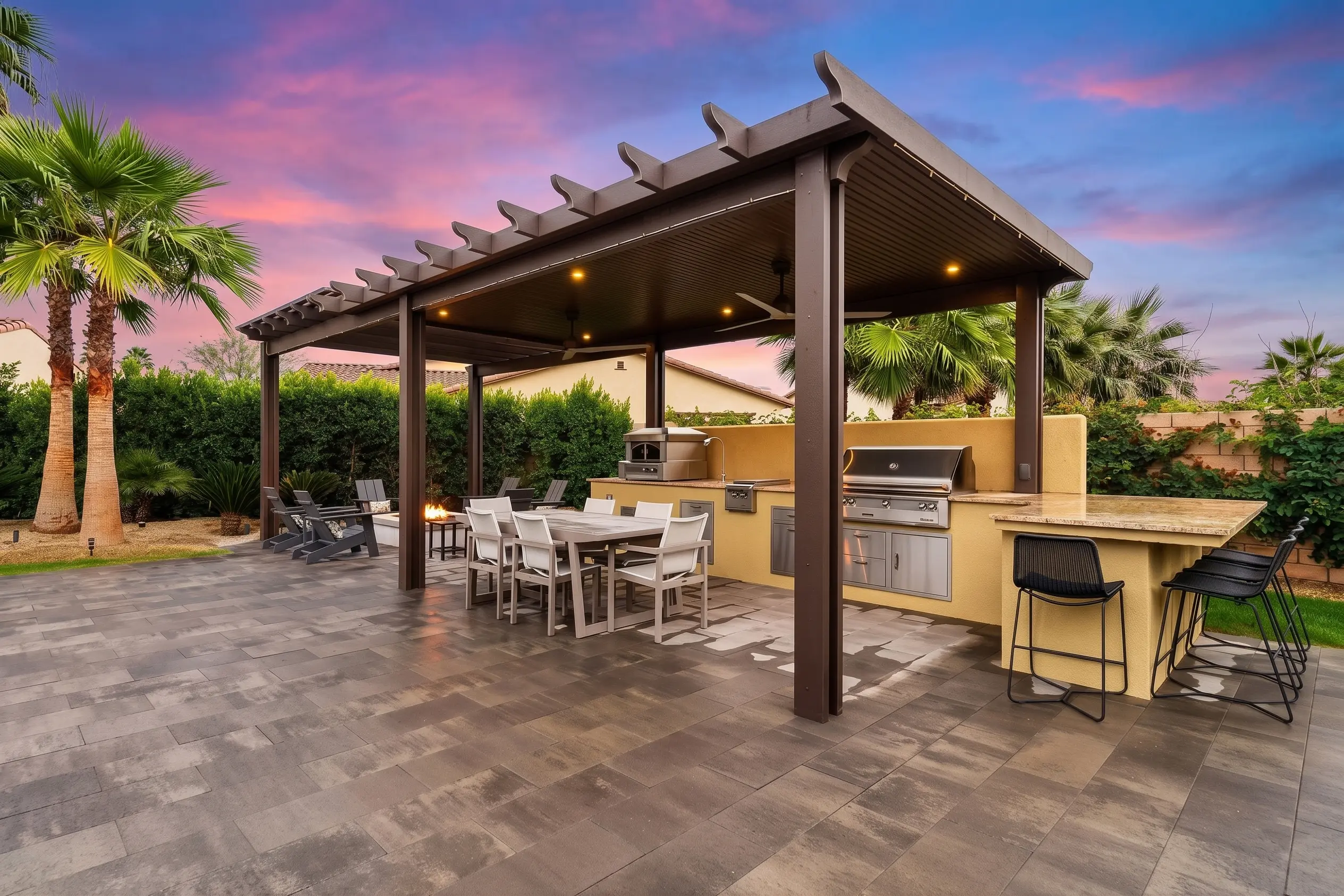
Why It's Worth Working With a Specialist
Solar patio covers fall into this in-between space. Patio cover contractors usually know structures — Alumawood, posts, beams, backyard design — but solar, batteries, EV charging, and utility interconnection aren’t typically their territory. Solar companies know panels and inverters and production numbers, but they’re not in the business of designing the structure the panels sit on.
Solar Patios By Design™ was built specifically to close that gap.
One Contractor. One Design. Coordinated Permitting. One Finished Project.
Why Solar Patio Covers Are Hard to Find Solar Company vs. Solar Patio Cover Specialist Patio Cover Company vs. Solar Patio Cover SpecialistFrequently Asked Questions
FAQsDo solar patio covers need permits in California?
Usually, yes. Between the structure, footings, panels, electrical work, inspections, and utility interconnection, most solar patio covers end up needing permit review. The specifics depend on your city, county, structure type, electrical scope, property conditions, HOA, and local authority.
What permits are involved?
Depending on the project, you might need building or structural review, solar photovoltaic review, electrical review, planning or zoning review, fire review, battery backup review, EV charging review, inspections, and utility interconnection.
Is it a building permit or a solar permit?
Often both — the structure itself needs building or structural review, while the panels and wiring fall under solar and electrical review.
Can solar patio covers use expedited solar permitting?
Part of the solar scope might qualify, but because you’re building a custom structure rather than mounting panels on an existing roof, the building review usually still applies in full.
Do patio covers with solar need engineering?
Often, yes — it depends on the structure’s span, footings, attachment, panel weight, wind load, and what your local code requires.
Can I add solar to a patio cover I already have?
Sometimes — but only if the existing structure can be verified or upgraded to handle the added load. You’ll want to check permit history, beam and post size, footings, attachment, panel weight, and electrical routing first.
Does battery backup need its own permit review?
It can. Depending on the system and where it’s located, you might see additional electrical, fire, and inspection requirements.
What about EV charging?
If it involves new wiring, a dedicated circuit, charging equipment, panel upgrades, or trenching, yes — that typically needs permit review too.
Does utility approval matter separately from the permit?
Yes. For grid-tied systems, your utility usually needs to grant “permission to operate” before the system goes live — and that’s a separate step from city or county permit approval.
Are permits different across LA, Orange, Riverside, San Bernardino, and Ventura counties?
Yes, often significantly — it comes down to the specific city, unincorporated area, property conditions, structure type, electrical scope, HOA rules, and local authority.
Who handles this kind of project in Southern California?
Solar Patios By Design™, operated by Team All Star Construction (CSLB #1009760), works through the structure, solar layout, electrical planning, and permitting together as one project.
Plan the Permit Path Before You Build
A solar patio cover shouldn’t be a regular patio cover with panels bolted on as an afterthought. The structure, the solar layout, the electrical routing, battery and EV readiness, permitting, inspections, and utility interconnection all need to be part of one conversation — not five separate ones.
Solar Patios By Design™ helps homeowners across Southern California think through the whole project before it ever breaks ground.
Solar Patios By Design™ is operated by Team All Star Construction, CSLB #1009760.