
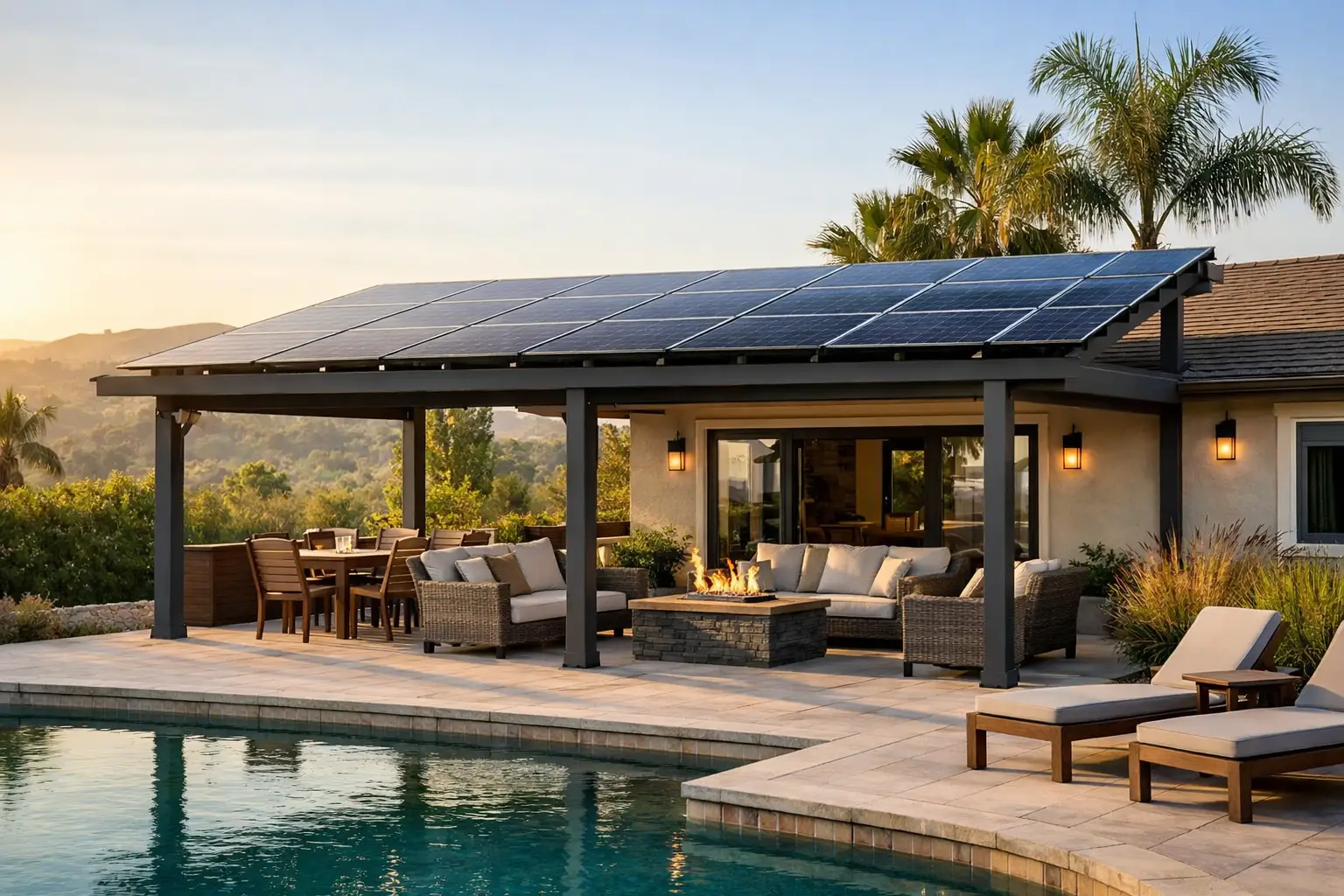
If you are pricing a new backyard upgrade and wondering about solar patio cover cost, the short answer is that most projects land well above the price of a standard patio cover and for good reason. You are not just buying shade. You are combining a structural improvement, a solar energy system, electrical work, design coordination, and permitting into one finished project.
That combination is exactly why cost questions can feel confusing. A basic patio cover contractor may quote one number. A solar company may quote another. But a true solar patio cover is neither of those things by itself. It is an outdoor living structure designed to generate electricity while improving comfort, appearance, and home value.
What is the typical solar patio cover cost?
In Southern California, a solar patio cover cost often falls somewhere between $25,000 and $70,000 or more, depending on size, structural design, roofing style, solar panel capacity, electrical upgrades, and site conditions. Smaller attached covers with modest solar production may come in at the lower end. Larger custom structures with premium finishes, integrated lighting, insulated roofing, battery readiness, or EV charging preparation can move well beyond that range.
That spread is wide because no two homes are exactly alike. A compact patio cover designed mainly for shade will price differently than a large backyard structure intended to offset a major portion of household electric use.
For homeowners used to looking at standard aluminum or wood patio cover pricing, this can feel high at first glance. But the more accurate comparison is not patio cover versus patio cover. It is patio cover plus solar system plus electrical coordination plus long-term energy production.
Why solar patio cover cost varies so much
The biggest driver is size. A larger structure uses more material, more labor, and can usually support more panels. That means higher upfront cost, but it also means greater energy production potential.
Design also matters. An attached patio cover tied into the home may have different engineering requirements than a detached structure. An insulated roof patio cover will price differently than a lattice-style pergola designed around solar panel placement. If a homeowner wants a more architectural look that complements the house, design upgrades can affect the final number just as much as square footage.
Then there is the solar side. The number of panels, panel wattage, inverter setup, electrical panel capacity, and whether the project is being designed for future battery backup all affect cost. If your home needs a main panel upgrade or additional electrical work to support the system, that can noticeably change the budget.
Site conditions are another variable homeowners often overlook. Sloped yards, limited access, concrete work, demolition of an old patio cover, and HOA documentation can all add complexity. In Southern California, local permitting rules can also vary by city and county, which affects both timeline and soft costs.
The patio cover itself is only part of the price
A common mistake is to assume the solar panels are simply added on top of a standard patio cover. In reality, a solar-ready or solar-integrated patio cover needs to be designed as a structure that can safely support panel loads, wind loads, attachment requirements, and electrical routing.
That means engineering is not an afterthought. The structure and solar system need to work together from the start. When they are treated as separate projects, homeowners often run into avoidable issues like awkward layouts, reduced panel capacity, unattractive conduit placement, or structural limitations that make the installation less efficient.
This is one reason turnkey design-build pricing can look different from piecing together multiple contractors. You are paying for integration, not just installation.
Solar patio cover cost vs. standard patio cover cost
A traditional patio cover in Southern California may cost significantly less than a solar version, especially if it is a simple non-insulated structure with no electrical features. But that lower initial price does not produce electricity, reduce utility bills, or create an alternative to rooftop solar.
For many homeowners, the better question is not, “What is the cheapest patio cover I can build?” It is, “If I already want shade and outdoor living space, does it make sense to make that structure work harder for me?”
That is where the idea of The Patio Cover That Pays You Back™ becomes practical rather than promotional. A standard patio cover improves comfort. A solar patio cover can improve comfort and generate long-term energy value.
When the cost makes more sense
Solar patio covers tend to make the most financial sense for homeowners who already need a patio cover, do not want solar on the roof, or have a roof that is not ideal for solar because of orientation, shading, age, or limited usable space.
They are also appealing for homeowners planning a larger backyard renovation. If you are already investing in an outdoor kitchen, new hardscaping, a seating area, or a more usable backyard layout, combining shade and solar into one project can feel more strategic than treating them as separate upgrades.
That does not mean a solar patio cover is automatically the lowest-cost path to solar power. Rooftop solar may still have a lower upfront cost in some cases. But rooftop solar is not the right fit for every home or every homeowner. Some people simply do not want panels mounted on the house, and that preference matters.
Local factors that affect solar patio cover cost
Southern California is an especially strong market for solar patio covers because the climate supports year-round outdoor living and strong solar production. Homeowners in Los Angeles County, Orange County, Riverside County, San Bernardino County, Ventura County, and San Diego County often want more shade without giving up a clean backyard design.
At the same time, local conditions can influence pricing. Coastal areas may have different material considerations than inland areas with more intense heat. HOA communities may require additional design review. Some cities have more involved permitting processes than others. And because property values are high across much of the region, many homeowners are thinking beyond utility savings alone. They are also looking at curb appeal, resale value, and how well a project fits the architecture of the home.
That is why local design experience matters. A solar patio cover is not just an energy product. It is a visible part of the property.
What should be included in the price?
When reviewing quotes, homeowners should look beyond the total number. A lower bid is not always the better value if it leaves out engineering, permit handling, electrical coordination, finish details, or a cohesive design approach.
A complete proposal should account for structural design, solar equipment, installation, electrical tie-in, and permitting. It should also clarify whether the project includes features such as lighting, fans, outlets, battery readiness, or EV charging readiness. Those items can be easier and more cost-effective to plan during the original build than to add later.
This is also where one-contractor coordination becomes important. Managing a patio cover builder and a separate solar installer can create gray areas around responsibility, scheduling, and design compromises. Homeowners usually feel the difference when one team is accountable for the full project.
Is financing part of the solar patio cover cost conversation?
For many households, yes. Because this is a larger home improvement project, financing often shapes how homeowners evaluate affordability. Some think of it as a backyard upgrade. Others see it as a combined shade, energy, and property value investment.
The right way to think about cost is usually in layers. There is the upfront price, the potential energy savings over time, the added utility of the outdoor space, and the possibility of avoiding a less desirable rooftop solar installation. Not every benefit shows up on the first invoice, but that does not make it less real.
How to tell if the price is worth it
The best projects tend to be the ones where the structure solves more than one problem. If you want shade, better outdoor living, a more attractive backyard, lower electric bills, and an alternative to roof-mounted panels, a solar patio cover can check several boxes at once.
If your only goal is to install the cheapest possible solar system, it may not be the best match. If your only goal is to add a simple budget patio cover, a standard cover may be enough. But if you want a project that improves how your home looks, feels, and performs, the value equation changes.
For homeowners throughout Southern California, that is often the real answer behind solar patio cover cost. You are not just pricing a structure. You are pricing a smarter outdoor living investment that can deliver shade today and energy benefits for years to come.
A well-designed solar patio cover should feel like it belongs with the home, supports the way you actually use your backyard, and gives you a practical path to solar without putting panels on your roof.