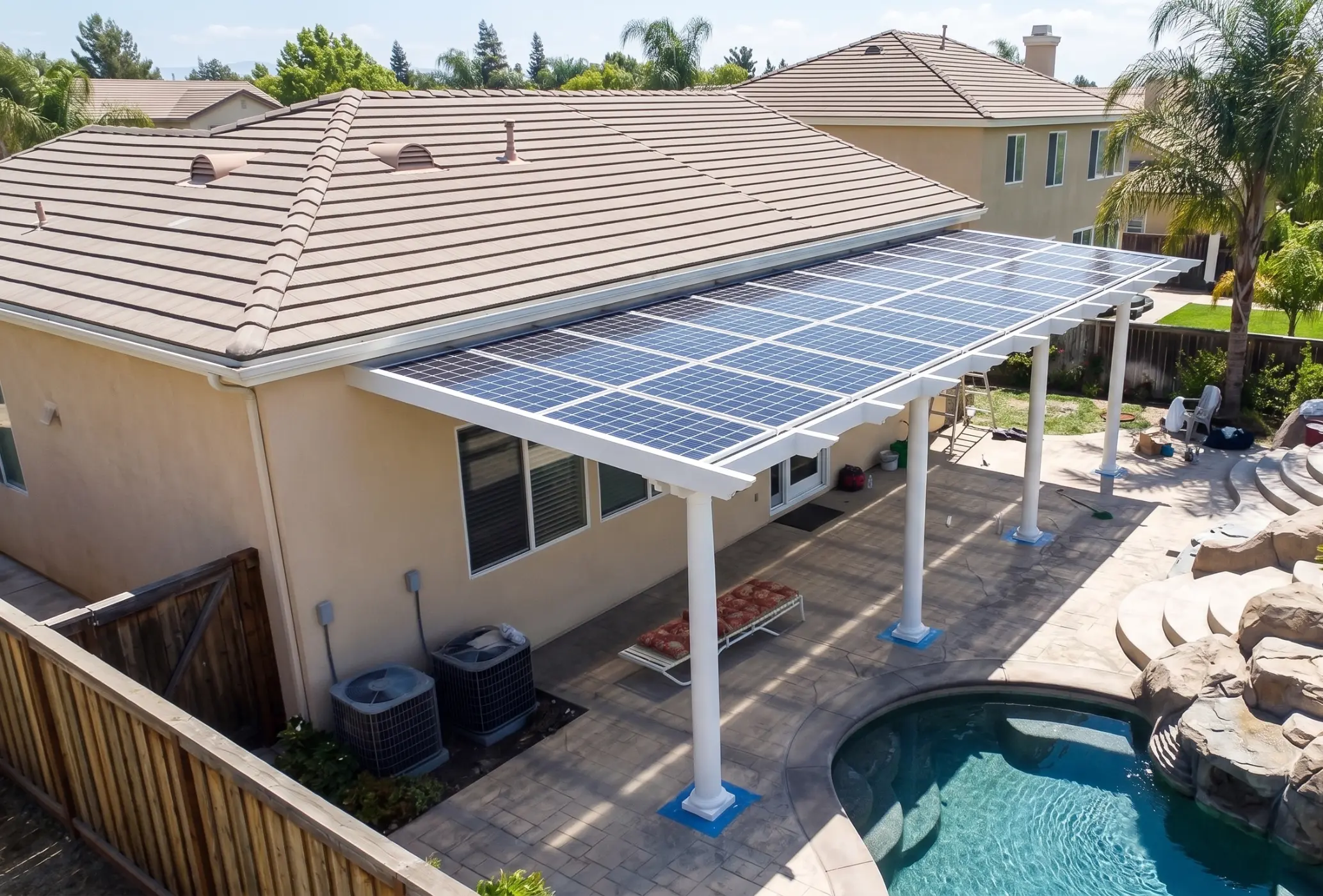
What Is a Solar Patio Cover in Placentia?
A solar patio cover is a patio roof purpose-built to hold solar panels while creating useful shade below. Rather than treating solar and structure as two separate jobs you bolt together later, you plan them as one thing from the start. That way the cover looks right, water drains properly, and it can actually support what you’re putting on top of it.
Before anything gets built, you need to work through the structure, solar placement, footings, how electrical gets routed, and drainage—all as one plan. Posts and beams have to be sized for the distances they span and the weight they’re carrying; footings need to suit your soil and what you’re building; conduit and junction boxes get integrated so it doesn’t look like you jury-rigged it. Good drainage and roof details keep water moving and the space feeling comfortable.
This is different from taking a standard patio cover and strapping panels on later. Retrofits get messy—the span might not support it, connection points are awkward, and wire routing becomes a nightmare. Starting with a unified design helps you avoid compromises and band-aid solutions. Head over to our main page for Solar Patio Covers to see how these projects really come together.
Why Solar Patio Covers Matter for Placentia Homes
Placentia homeowners deal with blazing sun that makes patios and pool decks unbearable during the hottest hours. A solar patio cover delivers real shade for dining, lounging, and cooking—and the roof above is built from the ground up to hold panels efficiently.
If your roof is tight on space, has shady spots you can’t use, or just doesn’t look right with panels, a patio cover with solar is often the smarter move. A lot of homeowners want panels somewhere other than the front of their house anyway, and a well-placed backyard structure gets plenty of sun while staying out of sight.
You can position the cover exactly where shade makes the biggest difference—over your grill, your dining area off the back door, or lounging spots by the pool—and size the panel array to match. That’s how you marry outdoor comfort with smart energy planning.
Not sure how a patio cover compares to roof solar for your situation? Check out Solar Patio Cover vs Roof Solar for some real considerations that might apply.
Solar Patio Cover Options in Placentia
You can build a solar patio cover attached to your home or set it as a detached structure where you need shade most. The right approach depends on your yard layout, how far back you can build, water drainage, and the solar placement you’re after.
Attached Solar Patio Covers
An attached solar patio cover connects straight to the house, usually right off the back door—perfect for outdoor dining and everyday use. The connection to the wall, how it meets your roofline, and drainage all get planned carefully so it looks like part of the home and water goes where it should. The structural design ties posts, beams, and spans to how you want the panels arranged above.
If your neighborhood has HOA design review, they’ll probably want to see how the attached cover looks, what color it is, and what the roof profile is like. See the details at /attached-solar-patio-covers/.
Detached Solar Patio Covers
Detached solar patio covers work great over pool seating, outdoor kitchens, garden areas, or anywhere you want a freestanding shaded spot. Footings, post layout, and beam spans all coordinate with your panel placement; electrical routing back to your main panel gets figured out upfront so there are no surprises later.
Setbacks, how water drains, and your property’s layout influence where and how big the structure can be. Browse examples and planning tips at /detached-solar-patio-covers/.
Alumawood Solar Patio Cover Options
Alumawood patio covers look clean and barely need maintenance. For solar, though, not every Alumawood setup will work without changes—spans, posts, footings, and beam sizes need to handle the solar load and panel layout you want.
We look at the structure and solar together to make sure your chosen profile, color, and finish line up with what’s structurally sound. Check out material and style options on our Alumawood Patio Covers page.
Our Solar Patio Cover Service in Placentia
Solar Patios By Design™ pulls the structure and the solar system into one coordinated plan. We look at your yard layout, where you want shade, and how you actually live outside—then design an attached or detached cover that’ll hold a solid solar array.
We handle shade planning, patio cover design, how the structure actually works, where footings and posts go, coordinating solar panel placement, and running electrical the right way. We also talk through material choices, Alumawood finishes, lighting, fans, gutters, and other details that matter to your home.
Most patio cover builders don’t touch solar. Most solar companies don’t know how to build a patio structure. We fill that gap so your cover, solar, electrical, and permits all move together as one project. That includes HOA support, permit paperwork, and getting ready for inspections.
Thinking ahead to battery backup or EV charging? We can build readiness into the electrical plan from the start. Want to talk financing options? We can walk through choices that might fit your budget—see Solar Patio Cover Financing for an overview.
One Contractor. One Design. Coordinated Permitting. One Finished Project.
Solar Patio Cover Cost Factors in Placentia
Every yard and design is different, so price gets shaped by structure size, design details, solar layout, how much electrical work is needed, and permit requirements. Site conditions, the finishes you want, and what the HOA or city says can shift things too.
We walk your property, check setbacks and routing options, and build a plan around your shade goals and energy priorities. For more detail on what drives cost, head to Solar Patio Cover Cost.
Swipe sideways to see every column.
| Cost Factor | Why It Matters |
|---|---|
| Patio cover size | Larger structures usually require more material, labor, structural planning, and solar layout coordination. |
| Attached or detached design | Detached structures may require more footing work, post planning, and electrical routing. |
| Solar panel layout | Panel count, spacing, direction, and exposure affect both the solar design and the structure below it. |
| Structural requirements | Posts, beams, spans, footings, and loads need to match the actual project design. |
| Electrical scope | Conduit routing, panel conditions, equipment location, battery readiness, and EV charging readiness can affect complexity. |
| Material and finish options | Alumawood style, color, roof profile, lighting, fans, gutters, and other upgrades can change the scope. |
| HOA review | Some communities may require design changes before approval. |
| Permit review | Requirements vary by city, county, structure type, electrical scope, and property conditions. |
| Site access | Backyard access, hardscape, slope, landscaping, and staging space can affect labor planning. |
| Battery or EV planning | Future energy goals may influence equipment layout and electrical planning. |
A real estimate should reflect what’s actually in your yard and how you plan to build it, not some generic number per square foot. We base proposals on measured conditions, your panel layout, and the specific finishes you care about.
Solar Patio Cover Permits and HOA Planning in Placentia
Depending on what you’re building, a solar patio cover might need structural review, electrical review, solar panel layout review, and inspections. What’s required varies by city, county, structure type, electrical scope, and property conditions. Some communities will also want separate HOA approval.
Our approach is to get the structure, solar, and electrical plan on the same page so submittals are clear and easy to follow. That means drawings showing posts, beams, spans, footings, roof details, drainage, and where equipment goes. When everything is coordinated from the start, the review process tends to go smoother.
HOA review usually focuses on how it looks—color, placement, that sort of thing. City or county review typically digs into structural and electrical details and inspection requirements. We guide you on what probably applies to your project and confirm the actual requirements with the right authorities.
Things that might come up during review:
- Patio cover location
- Property line setbacks
- Structure height
- Post placement
- Roof plane and drainage
- Solar panel visibility
- Exterior color and finish
- Electrical routing
- Footing requirements
- Fire access or special property conditions
- Whether the cover is attached or detached
For a broader look at submittals and inspections, check out Solar Patio Cover Permits California.
Solar Patio Cover Design Considerations for Placentia Homes
A great solar patio cover isn’t just panels overhead—it’s a thoughtfully planned outdoor room that fits your home and supports your solar array the right way. We start by figuring out where you actually sit, eat, and cook, then align the roof, posts, and spans so the solar layout above makes sense.
Design gets into the details: keeping solar panels visually integrated, running electrical cleanly without clutter, and managing water so it flows where it’s supposed to. For attached covers, the connection to your house matches your wall and roof situation. Detached structures get positioned with setbacks and how you use the space in mind.
We also think about furniture placement, where ceiling fans or lighting might go, and practical stuff like outlets near where you’ll actually need them. Color and finish should match what your HOA expects and what fits your home’s style. If battery backup or EV charging might be in your future, we can design for that possibility upfront.
Browse our Gallery to get a visual sense of scale, finishes, and layout ideas.
Solar Patio Cover vs Solar Pergola in Placentia
A solar patio cover usually gives you a more solid roof and consistent shade—ideal for dining areas, poolside spots, and places where you want real protection from sun and light rain. It’s roofed and integrated, holding panels close to the structure.
A solar pergola has a lighter, more open feel and works as a standalone feature with its own aesthetic. Some people love the pergola look, but the shade it casts is often dappled depending on how it’s designed.
Choosing between them comes down to your home’s style, how much shade you actually need, your solar goals, what the HOA will accept, how you use the space, what you want it to look like, and whether you’re going attached or detached. Learn more about pergolas at Solar Pergolas and comparisons at Solar Patio Cover vs Pergola.
Local Planning Notes for Placentia Homeowners
Placentia’s inland location means you get strong afternoon sun pretty reliably, especially over back patios and pools. A lot of homes do really well with shade right outside the sliding door for everyday dining, plus dedicated coverage near outdoor kitchens or lounge areas.
In planned neighborhoods, HOA or design review often centers on appearance, where you’re building it, and whether solar panels are visible. Roof space can be tight, or the roof might be aging, which pushes solar planning toward a backyard structure—especially if keeping the front of your house untouched makes sense.
Detached structures fit nicely around pools or garden seating where setbacks allow; attached covers are perfect for bringing indoor living outside. If you’re exploring options elsewhere in the county, our Orange County Service Area page has a broader picture of where we work and common questions that come up.
Why Choose Solar Patios By Design™ for Solar Patio Covers in Placentia
This kind of project really benefits from someone managing all the pieces. Patio cover building, structural planning, footings, solar panel placement, and electrical routing all affect each other—and then add permits, inspections, and HOA review on top. We bring it all together so the design works for both your lifestyle and your solar goals.
We engineer the structure to safely support the array while keeping posts, spans, and drainage aligned with how you’ll actually use the space underneath. Electrical gets routed with intention, considering equipment placement and any future battery backup or EV charging readiness you might want.
Most patio cover companies don’t do solar. Most solar companies don’t build patio structures. We bridge that gap with clear drawings, coordinated submittals, and real outdoor living guidance so the finished project feels like it was meant to be there.
Solar Patios By Design™ is operated by Team All Star Construction, CSLB #1009760.
Ready to talk about your yard and what matters to you? Start here: Get My Design & Estimate.
FAQs About Solar Patio Covers in Placentia
What is a solar patio cover?
A solar patio cover is a patio roof built to shade the space below while holding solar panels above. The structure, solar placement, drainage, and electrical all get planned together so everything works and looks clean.
Are solar patio covers a good fit for Placentia homes?
Absolutely, especially when your patio gets roasted by afternoon sun, roof space is tight, or you’d rather keep panels off a visible part of your roof. The cover makes the outdoor space actually usable, and the roof above gives you a great place for solar.
Do solar patio covers need permits in Placentia?
Permit requirements depend on your city, the county, what you’re building, how much electrical work is involved, and your property’s specific situation. Most projects will go through structural and electrical review with inspections, but we’ll confirm what applies to your design.
Does my HOA need to approve a solar patio cover?
Many HOA communities will want a say. They typically review location, appearance, color, and sometimes whether solar panels are visible. Exact requirements depend on your association’s rules.
How much does a solar patio cover cost in Placentia?
It depends on size, structure type, how many solar panels and where they go, electrical scope, materials and finishes, how easy it is to access your yard, and any adjustments from permits or HOA feedback. A site-specific estimate is the best way to figure out your range.
Can I plan battery backup or EV charging with a solar patio cover?
Yes—battery backup and EV charging readiness can both be designed in from day one. What makes sense depends on your goals and panel layout, and we can work through configurations that might support future upgrades.
What areas near Placentia do you serve?
We work throughout Orange County and surrounding communities. Availability depends on project scope and our schedule, and we’ll let you know during the initial chat.
Can an existing patio cover be upgraded to support solar?
Sometimes. It really depends on how it was built, the spans, the footings, and its overall condition. Some covers can be reinforced or redesigned; others would need a fresh start. A site visit tells us what’s actually feasible.
How long does design and permitting take?
Timelines vary based on how complex the design is, whether HOA review is needed, and how fast your city or county moves. We set expectations after looking at your property and keep you in the loop as things move through each stage.